 blog
blog
Concrete Paving Services: A Kansas City Guide
Table of Contents
- What Concrete Paving Services Include
- Concrete Parking Lot Installation and Design
- Site Preparation and Grading for Concrete Paving
- Concrete Parking Lot Repair and Maintenance
- Understanding Concrete Paving Cost and Budget Planning
- Why Professional Contractors Matter for Concrete Paving
- Project Timeline: What to Expect
- Frequently Asked Questions
Last Updated: October 12, 2026
What Concrete Paving Services Include
Concrete paving services cover the installation, repair, and maintenance that keeps driveways, parking lots, sidewalks, and commercial flatwork functional and attractive, backed by expertise in site assessment, material selection, installation, and durability.
At BK Concrete LLC, we handle every phase of concrete work, from initial site evaluation through final finishing, so you're not juggling multiple subcontractors.
The scope typically includes residential driveway and sidewalk installation, commercial project planning, parking lot design and installation, site preparation and grading, repair and maintenance, and custom finishes like exposed aggregate or decorative scoring.
Residential Driveway and Sidewalk Installation
Residential concrete paving services create durable surfaces that withstand freeze-thaw cycles, vehicle weight, and foot traffic.
A new driveway begins with site preparation: assess drainage, remove existing pavement, excavate to depth, compact the subgrade, and install base materials. This foundation work determines whether your driveway lasts 15 years or 30.
Sidewalk installation follows similar principles with different thickness and finishing standards. Contractors know local codes and ensure proper slope, a poorly sloped sidewalk creates ice hazards in winter or pooling water in spring.
Commercial Concrete Project Planning
Commercial concrete paving services demand a different approach: projects are larger, timelines tighter, and downtime costs money, so the contractor must manage scheduling, traffic, and stakeholders.
Commercial projects often require planning documents, staging areas, and phased schedules that minimize disruption. Whether it's a parking lot, loading dock, or foundation, the concrete paving services provider must coordinate with architects, engineers, and inspectors to meet specifications.
Concrete Parking Lot Installation and Design
Parking lot design combines engineering with functionality: accommodating vehicle loads, managing runoff, meeting accessibility standards, and incorporating proper slope for drainage.
The design phase determines whether your lot cracks prematurely or settles unevenly. Installation requires precise grading, rebar or wire mesh reinforcement, and correct thickness based on traffic and soil conditions.
Professional concrete paving services include layout planning for spaces, lanes, and turning radiuses, plus the right thickness, typically 4-6 inches for standard parking and 5-7 inches for heavy commercial use. Thinner concrete fails prematurely; thicker wastes money.
Site Preparation and Grading for Concrete Paving
Site preparation is where quality concrete paving services prove their value. Even perfect concrete poured on a poorly prepared base will fail within years.
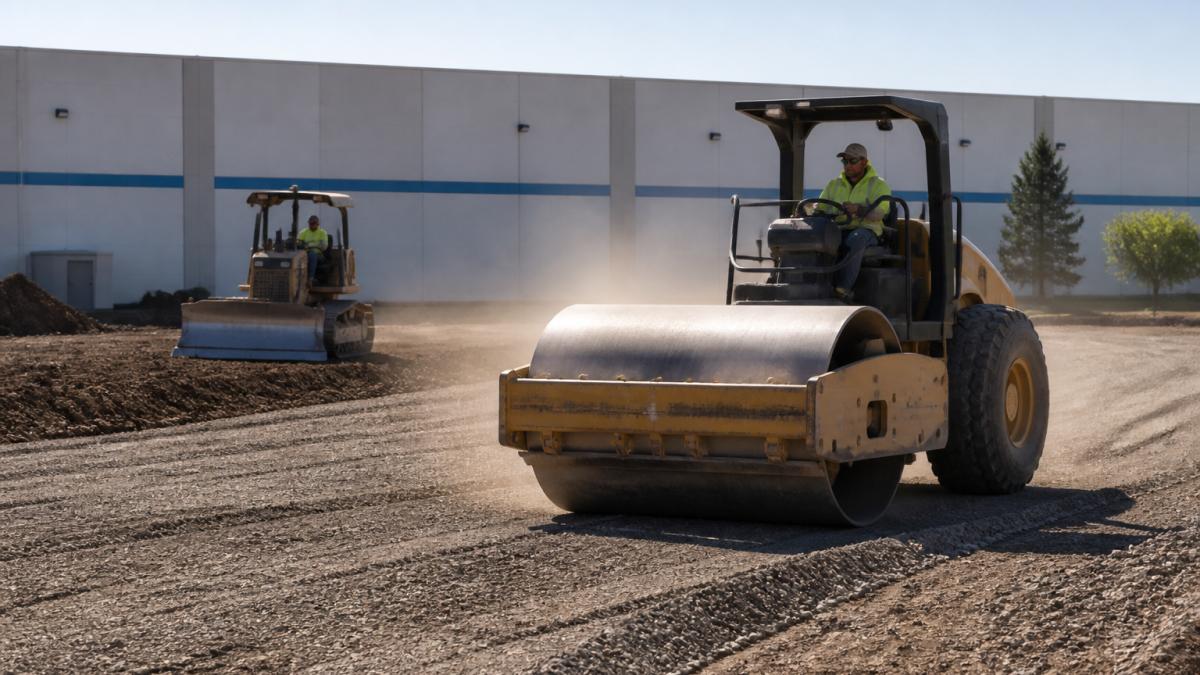
Proper grading establishes the correct elevation and slope for drainage. The contractor removes existing pavement, excavates to depth, removes unstable soil, and compacts the subgrade in layers, each verified for density.
Base material matters: crushed limestone, recycled asphalt, or engineered materials provide the stable foundation concrete needs.
Drainage planning is critical. Concrete paving services must address runoff through proper slope (typically 1-2% grade) and may add subsurface drainage where natural drainage is poor.
Concrete Parking Lot Repair and Maintenance
Concrete parking lots fail in predictable ways, and each failure mode points to a different repair. Knowing which is which, and when repair stops being worth it, is the core of managing a lot.
Common Failure Modes and What They Mean
Hairline and shrinkage cracks. These appear as concrete cures and are usually cosmetic if they stay tight. Sealing keeps water out and slows deterioration.
Widening or offset cracks. Cracks that widen, change elevation, or run across a slab signal a base problem, poor compaction, soil movement, or a missing control joint. Filling without addressing the base is temporary.
Spalling. Surface flaking or scaling is often caused by inadequate air entrainment, over-finishing, deicing salt, or freeze-thaw cycling, and worsens each winter.
Settling and slab displacement. Slabs that sink or rock indicate subgrade failure, poor drainage, or erosion beneath the slab, a structural issue, not a surface one.
Joint deterioration. Joints that crumble or lose sealant let water reach the base, which accelerates settling and freeze-thaw damage.
Repair Options and When Each Makes Sense
Crack sealing. The least expensive option and the right first response to tight, stable cracks: clean the crack, apply a flexible exterior-rated sealant, and re-seal as needed.
Partial-depth patching. For spalling and surface defects, a concrete patch restores the surface, best when the underlying slab is sound and the area is small.
Full-depth repair. When a slab section is broken, settled, or structurally compromised, removing and replacing that section is often more durable than patching over it.
Slab lifting (mudjacking or polyurethane injection). For settled but otherwise sound slabs, lifting back to grade is faster and less disruptive than replacement.
Resurfacing and overlays. A bonded or unbonded overlay restores a worn surface, but only if the base and slab are stable. Overlays on a failing base fail with it.
Repair Versus Replace: A Practical Decision Guide
A simple rule: if damage is surface-level and slabs are stable, repair. If it's structural, widespread settling, offset slabs, or a failing base, replacement is usually the better long-term investment.
Ask three questions:
- Is the base stable? If slabs rock, sink, or settled unevenly, the base is the problem and surface repairs won't fix it.
- How much of the lot is affected? Isolated failures can be repaired section by section; widespread failure usually favors replacement.
- What is the cost per square foot of repair versus replacement? When repair approaches a meaningful fraction of replacement cost, replacement is often better value because it resets service life.
A Maintenance Schedule That Protects the Investment
A practical annual routine for a concrete parking lot:
- Spring: Inspect for winter damage, new cracks, spalling, settled slabs. Clean debris from joints and drains.
- Summer: Re-seal joints and cracks before the next freeze-thaw cycle. Address any drainage issues while the weather allows.
- Fall: Clear drains and gutters, re-seal any open joints, and repair small defects before winter.
- Winter: Limit deicing salt where possible, keep drains clear of snow and ice, and avoid heavy equipment on slabs showing distress.
Sealing joints and cracks on a regular cycle is far less expensive than replacing slabs and is the single most effective maintenance action for extending a lot's service life. A concrete paving services provider can set up a schedule tailored to your lot's age, traffic, and drainage.
Understanding Concrete Paving Cost and Budget Planning
Concrete paving cost is usually quoted per square foot, but that number summarizes several separate line items. Understanding them is the difference between comparing bids intelligently and comparing by sticker price alone.
What Actually Drives the Price
Square footage and economy of scale. Concrete is priced per square foot, but the rate drops as the project grows.
Site preparation and excavation. The most underestimated line item. Removing existing pavement, hauling spoils, over-excavating unstable soil, and importing engineered base all add cost.
Concrete mix design. Standard 4,000 psi concrete is typical for residential flatwork.
Joints, sealants, and finishing details. Control joints, expansion joints, and joint sealant are not optional extras; they manage cracking and water intrusion.
Access, staging, and scheduling. Tight lots, steep grades, limited truck access, and work phased around business hours all raise labor cost.
How to Compare Bids Without Getting Burned
When you collect estimates, ask each contractor to break the quote into the same categories: demolition and haul-off, excavation and grading, base material and compaction, reinforcement, concrete mix and thickness, joints and sealant, finishing, curing method, and permits. A lump-sum bid is impossible to compare against an itemized one.
What an Estimate Should Include
A complete concrete paving estimate should state square footage, slab thickness, concrete strength and air entrainment, reinforcement type and spacing, base depth and material, joint layout, finish type, curing method, and whether permits and inspections are included. If any are missing, ask for them in writing before you sign.
Budget Planning Beyond the Pour
Plan for costs beyond the concrete itself: permit fees, possible engineering or survey work for commercial sites, temporary fencing or traffic control, and keeping vehicles off the new slab during curing. For commercial projects, factor in the business disruption of phased pours. A realistic budget accounts for the whole project, not just the concrete line item.
Why Professional Contractors Matter for Concrete Paving
Hiring a professional concrete paving services contractor versus DIY or inexperienced workers determines whether your project succeeds or fails.
Quality Workmanship and Durability
Professional contractors understand concrete chemistry, proper finishing techniques, and how environmental conditions affect curing, temperature, humidity, and wind all affect the final product.
Experienced contractors manage the concrete paving process to prevent common failures: proper air entrainment for freeze-thaw resistance, correct finishing to prevent scaling, and proper curing to achieve full strength. These details aren't visible but determine longevity.
A professional contractor stands behind their work.
Permits and Code Compliance
Professional concrete paving services include navigating local building codes and permitting requirements. Jurisdictions have specific requirements for driveway slope, parking lot design, accessibility, and drainage standards.
The contractor obtains permits, schedules inspections, and ensures the finished project meets code. This protects you from costly corrections or legal issues later, and proper permitting provides documentation that the work was done correctly if you sell.
Project Timeline: What to Expect
Understanding the concrete paving project timeline helps you plan around the work and set realistic expectations.
A typical residential driveway takes 1-2 weeks from start to finish, including site preparation, placement, finishing, and curing.
Concrete requires time to cure. You can drive on it after 7 days, but full strength develops over 28 days.
Larger commercial projects take longer. Parking lot installation might require 2-4 weeks depending on size and site conditions.
Weather delays are common. Rain stops concrete work. Extreme heat or cold requires special measures. Professional contractors plan for weather contingencies and communicate delays promptly.
Choosing professional concrete paving services protects your property investment. BK Concrete LLC manages every stage of concrete projects, from site preparation and grading through finishing and curing.
| Project Type | Typical Duration | Site Prep Time | Concrete Work | Curing Period |
|---|---|---|---|---|
| Residential Driveway | 1-2 weeks | 2-3 days | 1-2 days | 7-28 days |
| Commercial Parking Lot | 2-4 weeks | 3-5 days | 2-5 days | 7-28 days |
| Sidewalk Installation | 3-7 days | 1-2 days | 1 day | 7-14 days |
| Concrete Repair | 1-3 days | varies | 1-2 days | 3-7 days |
Frequently Asked Questions
What is included in a complete concrete paving service?
Professional concrete paving services include site assessment, excavation and grading, base preparation, rebar reinforcement installation, concrete pouring and finishing, and surface sealing. Full-service providers handle permits, drainage planning, and code compliance to ensure your project meets local requirements. Quality contractors also provide post-installation maintenance guidance.
How do I choose a reliable concrete paving contractor?
Look for contractors who are bonded and insured, have verifiable customer reviews and ratings, provide detailed written estimates. Ask about their experience with projects similar to yours, residential driveways, commercial parking lots, or industrial foundations. Request references and examples of completed work. A reputable contractor should be transparent about timelines, materials, and what happens if issues arise after installation.
What factors affect concrete paving cost?
Concrete paving cost depends on project size (square footage), site conditions, base preparation requirements, concrete thickness specifications, finish type, local labor rates, and material availability. Commercial parking lot installation typically costs more per square foot than residential driveways because of thicker concrete, reinforcement requirements, and drainage infrastructure. Get multiple estimates and ask contractors to explain their pricing breakdown so you understand what drives the total.
How long does a concrete paving project typically take?
Small residential driveways usually take 3-7 days from start to finish, including site prep and curing time. Larger commercial concrete parking lot installation can take 2-4 weeks depending on size, weather, and site conditions. Weather delays, soil conditions, and permit processing can extend timelines. Professional contractors provide realistic schedules upfront and communicate if delays occur. Ask your contractor for a detailed project timeline before work begins.