 how-to
Residential Concrete Driveway Cost Estimator
Table of Contents
- How to Use a Concrete Driveway Cost Estimator
- Concrete Driveway Cost Per Square Foot
- Calculating Concrete Volume and Cubic Yards
- Concrete Driveway Installation Cost Breakdown
- Concrete Driveway Replacement Cost Factors
- Cost Variations by Driveway Size and Type
- Hidden Costs and What Estimates Should Include
- Local Pricing Adjustments and Site Conditions
- Frequently Asked Questions
Last Updated: October 11, 2026
How to Use a Concrete Driveway Cost Estimator
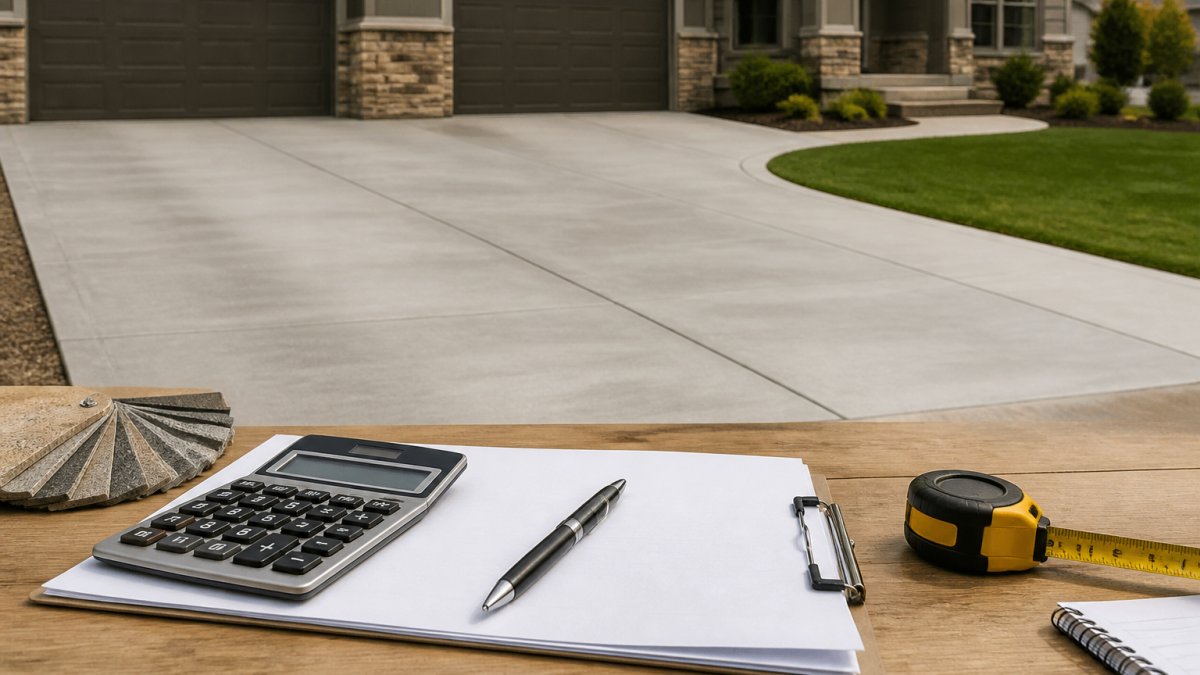
A residential concrete driveway cost estimator is an online tool that calculates total project expense by factoring in driveway dimensions, concrete type, site conditions, and local labor rates. BK Concrete LLC's estimator helps homeowners get accurate ballpark figures before requesting formal quotes.
Most estimators ask three core questions: driveway size, finish type, and location. The tool multiplies square footage by regional per-square-foot pricing and adds labor, site prep, and delivery to produce a preliminary cost range, not a locked-in price.
Accuracy depends on input detail. Precise measurements of length, width, and slab thickness produce estimates that typically fall within 10-15% of actual contractor quotes.
Concrete Driveway Cost Per Square Foot
The concrete driveway cost per square foot is the most useful metric for comparing quotes and scaling estimates. This figure varies widely by region, finish type, and site complexity.
National Baseline and Regional Multipliers
Plain concrete driveways typically range from $8 to $18 per square foot for complete installation. This range reflects regional differences in labor rates, concrete availability, and permitting requirements.
To adapt a national baseline to your location, identify your region's labor-cost multiplier:
- High-cost urban markets (Northeast, California, Pacific Northwest): Apply a multiplier of 1.3 to 1.5× the national baseline. A $12/sq ft national average becomes $15.60-$18/sq ft in these areas.
- Mid-range markets (Midwest, Mid-Atlantic, parts of the South): Use a multiplier of 0.9 to 1.1×. These regions often align closely with national averages.
- Lower-cost rural and Southern markets: Apply 0.75 to 0.95×. A $12/sq ft baseline drops to $9-$11.40/sq ft.
These multipliers reflect prevailing wage rates and concrete batch-plant density. Urban areas with union labor and longer delivery distances cost more; rural areas with lower labor rates cost less.
How Finish Type Affects Per-Square-Foot Cost
Plain concrete is the baseline. All other finishes add cost in predictable increments:
- Plain concrete (broom finish or standard trowel): Baseline cost, no premium.
- Colored concrete: Add $1-$3/sq ft. Pigment additives and precise batch mixing require extra labor and material cost.
- Stamped or textured concrete: Add $3-$8/sq ft. Specialized tools, extended finishing time, and skilled labor drive the premium. Complex patterns cost more than simple textures.
- Exposed aggregate or polished concrete: Add $4-$10/sq ft. These finishes demand specialized equipment and extended curing protocols.
A 500-square-foot driveway at $12/sq ft baseline costs $6,000 in plain concrete; with a stamped finish at $17/sq ft, it costs $8,500, a $2,500 premium.
Site Complexity and Hidden Per-Square-Foot Multipliers
Your actual cost per square foot also depends on site conditions that inflate labor and material requirements:
- Straightforward new driveway on prepared ground: No multiplier; use baseline.
- Existing driveway removal and disposal: Add 15-25% to total cost. Demolition, hauling, and base preparation consume labor hours.
- Poor drainage or grading work required: Add 10-20%. Extensive grading, drainage tile installation, or soil amendment increase labor and material.
- Difficult access or steep slope: Add 20-35%. Limited truck access, tight site geometry, or slopes exceeding 2% require alternative equipment or hand finishing, both labor-intensive.
- Utility locate or underground obstacles: Add 5-10%. Locating and working around gas, electric, water, or telecommunications lines adds time and complexity.
A 500-square-foot driveway at $12/sq ft baseline ($6,000) with existing removal and poor drainage becomes approximately $8,625, a 44% increase driven by site conditions.
Using Per-Square-Foot Estimates to Validate Contractor Quotes
When you receive a contractor quote, divide the total cost by your driveway's square footage to derive the effective per-square-foot price. Compare this figure against your adjusted baseline:
- Calculate your regional baseline using the multipliers above.
- Add finish-type premiums if applicable.
- Add site-complexity multipliers based on your property's conditions.
- Divide the contractor's total quote by your square footage.
- If the contractor's per-square-foot figure is 15-20% higher than your adjusted baseline, request an itemized breakdown to understand what drives the difference (e.g., thicker slab, premium reinforcement, extensive prep work).
- If the figure is more than 25% higher without clear justification, seek a second quote.
This approach prevents you from overpaying for straightforward work while ensuring you account for legitimate cost drivers on complex sites.
Calculating Concrete Volume and Cubic Yards
Measuring Length, Width, and Slab Thickness
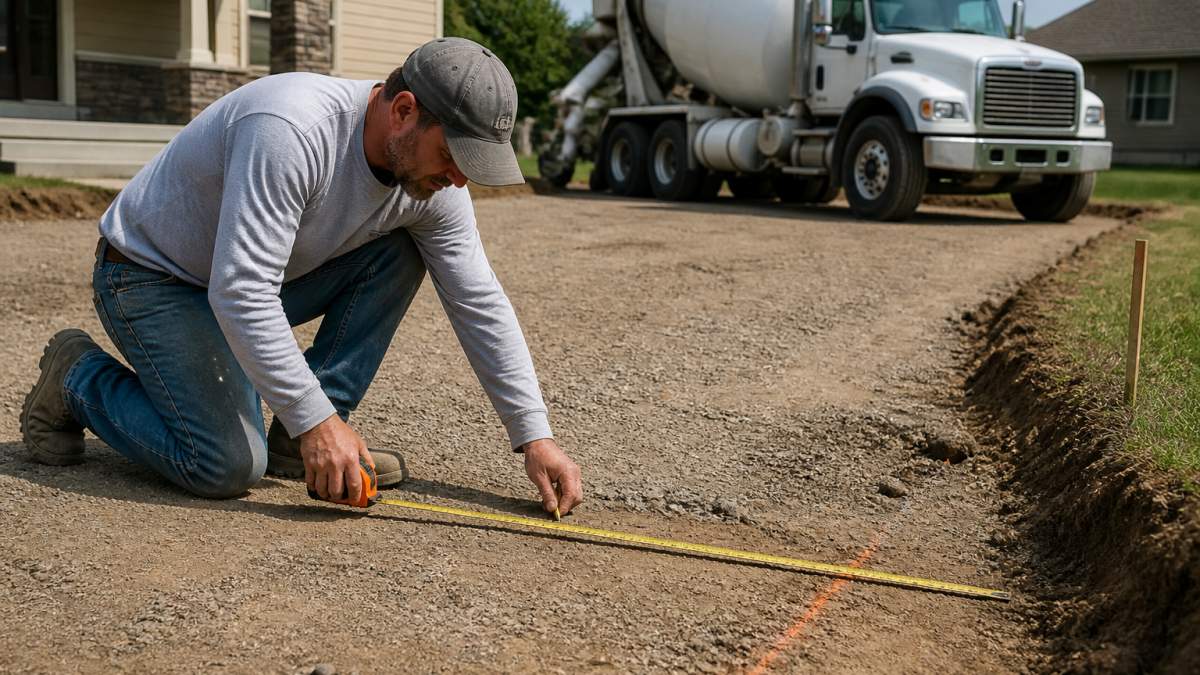
To calculate concrete volume, measure driveway length, width, and slab thickness. Slab thickness for residential driveways is typically 4 inches (single-car) or 6 inches (two-car). A typical single-car driveway is 12 feet wide by 20 feet long; a two-car driveway is 20 feet wide by 20-24 feet long.
Converting to Cubic Yards
Convert to cubic yards by multiplying length × width × thickness (in feet), then dividing by 27. Example: 12 ft × 20 ft × 0.33 ft (4 inches) ÷ 27 = 2.93 cubic yards. Most residential driveways require 2-8 cubic yards.
Concrete Driveway Installation Cost Breakdown
Material Costs
Ready-mix concrete pricing depends on market conditions, distance from the batch plant, and delivery fees. Materials also include reinforcement (rebar or wire mesh), base gravel, and sealant. Material costs scale with project size and site conditions.
Labor and Contractor Fees
Labor is the largest cost component. Straightforward pours require less labor than jobs involving removal, grading, or decorative work. Contractors typically charge by square foot or provide scope-based estimates.
Site Preparation and Removal
Site preparation costs depend on existing conditions. Replacement projects require removal and disposal; new driveways on virgin ground require less prep. Proper grading ensures drainage and meets municipal code requirements.
Concrete Driveway Replacement Cost Factors
Replacement projects cost more due to demolition and disposal. Subgrade condition affects costs; poor drainage or settlement must be addressed before pouring to prevent premature cracking. Permits and inspections may be required; check with your local building department.
Cost Variations by Driveway Size and Type
Small Driveways
Small driveways (under 400 sq ft) may have higher per-square-foot costs because fixed costs like delivery and mobilization are spread across fewer square feet. A 12 × 30 ft driveway (360 sq ft) requires approximately 4 cubic yards.
Two-Car and Medium Driveways
Two-car driveways (400-600 sq ft) often offer the most economical per-square-foot cost. A standard 20 × 25 ft driveway (500 sq ft) is considered the "sweet spot" for efficient material and labor deployment.
Decorative Finishes and Colored Concrete
Decorative finishes (stamped, colored, exposed aggregate) significantly increase costs and require specialized tools and skilled labor. These finishes enhance curb appeal and can influence resale value.
Hidden Costs and What Estimates Should Include
A comprehensive estimate should itemize every cost component to help you compare bids accurately and avoid surprises.
The Itemized Estimate Checklist
Before accepting any concrete driveway quote, verify that it explicitly includes or excludes each of these line items. A professional estimate should break down costs this way:
Site Preparation & Demolition
- Existing driveway removal and disposal (if applicable)
- Excavation and grading to achieve proper slope (typically 1-2% slope away from structures)
- Base material (gravel or crushed stone, usually 4-6 inches deep)
- Utility locate service (required by law in most states before excavation)
Concrete Material & Delivery
- Ready-mix concrete (specify cubic yards and strength, e.g., 3,000 PSI)
- Concrete delivery fee (often $10-$20 per cubic yard or a flat trip charge)
- Reinforcement (rebar, wire mesh, or fiber reinforcement, specify type and quantity)
Labor & Installation
- Form setup and removal
- Concrete placement and finishing (broom finish, trowel finish, or decorative work)
- Curing management (moisture retention, temperature protection if needed)
- Cleanup and debris removal
Finishing & Protection
- Concrete sealer application (if included; many contractors charge separately)
- Decorative finishes (stamped, colored, or exposed aggregate, if applicable)
Permits, Inspections & Compliance
- Building permit fee (varies by jurisdiction; typically $50-$300)
- Inspection fee (if required; often $50-$150 per inspection)
- Drainage or runoff compliance work (if local code requires)
Contingency & Warranty
- Contingency allowance (typically 5-10% of total cost for unforeseen conditions)
- Warranty period (e.g., "1 year labor, 5 years material defects")
Red Flags in Contractor Quotes
Ask for clarification if a quote uses vague language or omits categories. Red flags include: slab thickness not specified, reinforcement omitted, existing removal not priced, permits listed as homeowner responsibility, sealer application deferred, or drainage work vague or missing.
How to Compare Multiple Quotes
When comparing bids: (1) Ensure scope is identical, same square footage, slab thickness, finish type, and site conditions. (2) Extract per-square-foot cost by dividing total by square footage. (3) Check what's included: removal, sealer, permits, reinforcement, contingency. (4) Identify cost drivers for significant differences. (5) Verify contractor licensing and insurance.
What Estimates Should NOT Include (and Why)
Some costs are genuinely outside the scope of a driveway installation and should not appear in a concrete contractor's quote:
- Landscaping or hardscape work (patios, walkways, retaining walls): These are separate projects with separate bids.
- Electrical or utility work (outdoor lighting, conduit installation): Hire a licensed electrician if needed.
- Structural repairs to your home (foundation work, drainage systems): These require a structural engineer or foundation specialist.
If a contractor bundles unrelated work into a single quote, request separate line items or separate bids from specialists.
Warranty and Dispute Resolution
A professional estimate should include a warranty statement. Typical concrete driveway warranties cover:
- Labor defects: 1-2 years. The contractor fixes finishing issues, cracks due to poor workmanship, or improper slope at no charge.
- Material defects: 5-10 years. The concrete supplier or contractor covers premature spalling, severe cracking, or surface deterioration due to material failure.
- Exclusions: Most warranties exclude damage from freeze-thaw cycles (in cold climates), salt exposure, heavy vehicle impact, or poor maintenance.
Before signing, ask the contractor to provide their warranty in writing and clarify what is and is not covered. This prevents disputes if problems arise after installation.
Local Pricing Adjustments and Site Conditions
Regional pricing for concrete driveways varies significantly across the country. Labor rates, concrete availability, and local market conditions all influence final costs. An estimator designed for national use cannot account for these regional variations precisely.
Your specific location affects pricing in multiple ways. Urban markets typically have higher labor costs than rural areas. Regions with abundant concrete production facilities may offer lower material costs than areas requiring long-distance delivery.
Site conditions unique to your property influence costs beyond standard calculations. Steep slopes require more extensive grading. Poor soil drainage necessitates additional base preparation. Difficult access for concrete trucks may require alternative delivery methods, adding cost.
When using a concrete driveway cost estimator, adjust the results based on your local market and site-specific factors. The estimate provides a starting point.
Understanding how to use a residential concrete driveway cost estimator helps you to plan your project confidently. BK Concrete LLC's online tools give you quick, transparent estimates based on your specific dimensions and location.
Frequently Asked Questions
What is the average cost to put in a concrete driveway?
The total project cost for a residential concrete driveway depends on size, site conditions, and regional pricing. Most homeowners should request estimates from local contractors to understand their specific costs. Factors like existing driveway removal, soil preparation, and concrete thickness all affect the final price. Your contractor can provide a detailed estimate once they assess your property and understand your project scope.
How do I estimate concrete for a driveway using a cost calculator?
Start by measuring your driveway's length, width, and desired slab thickness in inches. Multiply length × width to get square footage. Then calculate cubic yards by multiplying square footage by thickness in inches, dividing by 324. A concrete driveway cost calculator takes these measurements and applies material costs, labor rates, and local pricing to give you a project estimate. Be prepared to provide site details like existing driveway removal needs and soil conditions for accuracy.
What factors affect the cost of a residential concrete driveway?
Key factors include driveway size and square footage, concrete thickness and volume needed in cubic yards, site preparation and excavation requirements, whether you're removing an existing driveway, reinforcement needs like rebar, decorative finishes such as stamped or colored concrete, delivery costs, and your regional location. Drainage and grading complexity, local labor rates, and permits also impact your total installed cost. Each factor can significantly change your project estimate.
How much does a 20x40 concrete driveway cost?
A 20x40 driveway is 800 square feet. The concrete driveway cost per square foot varies by region and finish type, but your total cost also depends on thickness, site preparation, removal of existing concrete, and whether you choose plain concrete or decorative options. Request quotes from local contractors who can assess your specific site conditions and provide an accurate estimate. Delivery costs and labor rates in your area will significantly influence the final price.