 how-to
Avoid Concrete Contractor Price Escalation: 2026 Guide
Table of Contents
- Why Concrete Bids Rise After You Sign
- How a Fixed-Price Concrete Contract Protects Your Budget
- Reading a Construction Material Price Escalation Clause
- How to Negotiate a Concrete Contractor Quote
- Walking Through the Concrete Project Change Order Process
- Spotting an Unsupported Price Increase vs. Real Concrete Price Escalation
- Conclusion: Locking In Your Concrete Price Before the Pour
- Frequently Asked Questions
Last Updated: October 14, 2026
Why Concrete Bids Rise After You Sign
Avoiding concrete contractor price escalation starts with knowing why quotes move.
This guide from BK Concrete LLC covers the contract terms that decide who pays when prices jump: reading an escalation clause, negotiating a firm number, and catching a padded invoice before you write a check.
A price escalation clause is a contract provision that lets a contractor raise the agreed price when defined costs rise beyond a set threshold. Without one, a fixed bid usually holds.
What Drives Material and Labor Costs Up
Supply-chain delays and market volatility move concrete prices most.
- Cement and aggregate costs shift with energy and freight rates
- Rebar prices track scrap steel markets
- Ready-mix plants add fuel surcharges when diesel climbs
Material availability matters too. When a plant is booked out, lead time grows and rush fees appear. According to Federal Reserve economic data on construction materials, input costs for construction have swung widely in recent years.
How a Fixed-Price Concrete Contract Protects Your Budget
A fixed-price contract locks one number for a defined scope of work; it doesn't move unless the scope changes. You get certainty, and the contractor carries the risk of rising costs. Many contractors price that risk in, so a firm bid often runs a little higher than an adjustable one, for most homeowners, the certainty is worth it.
What a Fixed-Price Contract Should Cover
A solid fixed-price agreement spells out:
- The full scope of work, including prep, grading, and rebar
- The contract price and payment schedule
- A bid validity period
If a contract calls itself fixed-price but includes an open-ended escalation clause, it isn't fixed. It's a fixed price with an escape hatch.
Here's how the two common contract types compare:
| Contract Type | Price Risk Sits With | Best For | Watch Out For |
|---|---|---|---|
| Fixed-price | Contractor | Owners who need budget certainty | Higher base bid, narrow scope |
| Price-adjustment | Owner | Long projects, volatile markets | Vague triggers, no cap |
Reading a Construction Material Price Escalation Clause
A construction material price escalation clause defines when and how the price can change. If you read only one part of your agreement, read this one.
These clauses aren't automatically unfair. On a long project, some adjustment is reasonable. The problem is a clause with no limits.
Triggers, Thresholds, Caps, and Floors
Four parts decide how much a clause can cost you:
- Trigger: the event that starts an adjustment, like a supplier price increase or a documented delay
- Threshold: how big the change must be before it counts, often a small percentage band
- Cap: the most the price can rise, which protects your budget
A clause with a trigger but no cap is a blank check. Ask for a cap in writing.
How to Negotiate a Concrete Contractor Quote
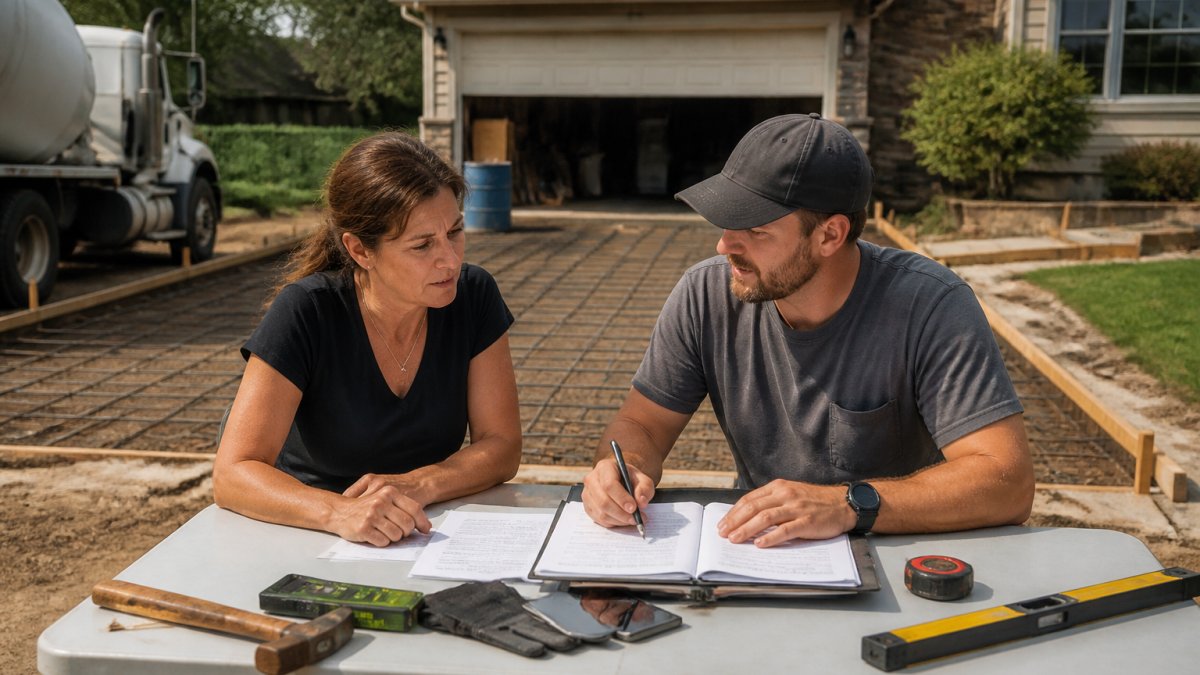
Negotiation is about clarity, not pressure. The strongest move is asking the contractor to itemize material, labor, and contingency separately, then comparing those line items across every bid.
What Actually Drives a Concrete Quote
Before negotiating, know which line items are real cost drivers and which are padding:
- Mix design and strength. A 3,000 psi sidewalk mix costs less per cubic yard than a 4,500 psi driveway mix with freeze-thaw exposure. Air-entrainment, fiber mesh, and accelerators each add cost.
- Reinforcement. Welded wire mesh, #3 or #4 rebar grids, and fiber-reinforced mixes are priced differently. Spacing matters, 12-inch on-center rebar uses roughly twice the steel of 24-inch on-center.
- Excavation and subgrade prep. Removing existing concrete, hauling spoils, and compacting a proper base is labor-heavy. A low bid that skips 4 to 6 inches of compacted gravel is not a bargain.
When a contractor says "prices went up," ask which line item changed. A vague answer means the increase isn't tied to a real cost driver.
A Bid-Comparison Checklist
Ask every bidder for the same information so you can compare apples to apples:
- A written scope of work with quantities, square footage, thickness, cubic yards, rebar size and spacing
- The mix design and compressive strength in psi
- Base preparation depth and material
- A firm bid validity period (30, 60, or 90 days)
- What happens if material prices move before the pour
- A cap on any adjustment, in dollars or a percentage
- Who pulls permits and who pays for inspections
- A payment schedule tied to milestones, not calendar dates
- A written change-order process
- Warranty terms and what voids them
If a bid comes in far below the others, ask why. Low bids often hide thin prep, missing reinforcement, or a weak mix, shortcuts that show up as cracks and callbacks within a few seasons.
Negotiating the Escalation Terms
You will rarely talk a contractor out of a fair price. You can, however, negotiate the risk-sharing terms:
- Ask for a bid validity period long enough to cover your decision window.
- Push for a cap on any price adjustment, even if it is a percentage of the contract price.
- Request an objective benchmark, a published index or a supplier quote, rather than "prevailing market rates."
Sample Clause Language You Can Ask For
You don't need to be a lawyer to ask for clearer language. A plain-language cap clause might read:
"The contract price is firm for 60 days from the date of signing. After that date, the price may be adjusted only for documented increases in the cost of ready-mix concrete or steel reinforcement, supported by supplier invoices. Total adjustments shall not exceed 5% of the original contract price. The contractor must provide written notice with supporting documentation within 10 days of the cost change. No adjustment shall be made for costs incurred before written notice is given."
That paragraph sets a validity window, limits the increase, requires evidence, and sets a notice deadline. Ask your contractor to include something similar, or explain in writing why they won't.
Worked Example: How a Capped Adjustment Is Calculated
Suppose your signed contract price is $12,000 for a 600-square-foot driveway, with a 5% cap tied to ready-mix supplier invoices.
- The supplier's price for your mix rises by $18 per cubic yard.
- Your pour uses 12 cubic yards.
- The documented increase is 12 × $18 = $216.
Now suppose the increase is $60 per cubic yard: 12 × $60 = $720, which exceeds the $600 cap, so the contractor can only pass through $600.
If your contractor cannot show you this math on paper, you are not looking at a capped clause. You are looking at a promise.
Walking Through the Concrete Project Change Order Process
A change order is a written amendment that adjusts scope, price, or schedule after signing. No change order, no extra charge, hold that rule.
The process should look like this:
- You or the contractor identifies a needed change
- The contractor submits a written notice with the reason
- You receive a price and time impact in writing
- You approve or reject it before work continues
- Both sides sign, and the document joins the contract
Keep supporting records for every change. Photos, messages, and signed forms protect both sides. If a contractor asks for more money without paperwork, that's not a change order. It's a request.
Spotting an Unsupported Price Increase vs. Real Concrete Price Escalation
Real concrete price escalation comes with evidence; an unsupported increase comes with a story. Most homeowners pay before seeing the paperwork, and by then, the leverage is gone. Here is a verification workflow you can run the moment a contractor asks for more money.
The Four-Part Verification Test
Before you approve any increase, require the contractor to answer four questions in writing:
- Which item changed? The contractor must name the specific cost, ready-mix concrete, rebar, pump rental, labor rate, not "materials" or "the market."
- What is the contractual basis? Point to the exact clause in your signed agreement that permits the adjustment. If there is no clause, there is no adjustment.
- What is the evidence of the cost change? Supplier invoices, dated quotes, or the published index named in the contract. A screenshot of a news article is not evidence.
- How was the adjustment calculated? Ask for the math: quantity × unit cost change, then apply the threshold and cap. If the number cannot be reproduced on a calculator, it is not a valid adjustment.
If any answer is missing, the increase is unsupported. Asking isn't being difficult, you're enforcing the contract you both signed.
Red Flags That Signal an Unsupported Increase
Watch for these patterns:
- The increase arrives after the work is complete, with no prior written notice
- The contractor cites "market conditions" without naming a supplier or index
- The percentage is round and convenient, 10% or 15% with no supporting math
A legitimate escalation claim survives these tests; an unsupported one usually collapses at question two.
What to Do If the Contractor Refuses to Provide Evidence
You have options short of paying:
- Request the documentation in writing and give a reasonable deadline, such as five business days.
- Withhold only the disputed amount, not the entire invoice, if the contract and local law allow it. Paying the undisputed portion in good faith strengthens your position.
- Send a written dispute letter stating the amount in dispute, the reason, and what documentation you requested. Keep a copy.
Keeping a Dispute File
If a disagreement is brewing, start a file the same day. Include:
- The signed contract and any addenda
- Every written notice from the contractor, with dates
- Supplier invoices or quotes the contractor provided
This file is what a mediator, licensing board, or judge will look at. A clear paper trail is the most effective protection against an unsupported increase.
Conclusion: Locking In Your Concrete Price Before the Pour
Price swings are a fact of construction, but surprise invoices are not. Prevent most of them with a clear scope, a firm bid validity period, and a cap on any adjustment.
BK Concrete LLC handles site preparation, grading, and rebar reinforcement as part of every project, and our interactive online cost estimator gives you a quick ballpark before we ever visit the site.
Calculate a job estimate with BK Concrete LLC and lock in your number before the pour.
Frequently Asked Questions
Can a contractor raise the price after I sign a fixed-price contract?
Only if the contract itself allows it. A true fixed-price concrete contract locks the number for the defined scope of work, so the contractor absorbs material price increases unless the agreement includes an escalation clause, a contingency allowance, or a force majeure provision that covers cost changes. Read those sections before signing. If the contract says the price is firm with no adjustment language, a later increase for the same scope is generally not enforceable, and you can ask for written justification tied to a signed change order.
How can I tell whether a concrete contractor's price increase is justified?
Ask for three things: the specific cost that changed, a written notice explaining it, and supporting records such as supplier quotes or a published price index. Legitimate concrete price escalation ties back to an objective benchmark, like a regional ready-mix or cement index, and matches the adjustment formula in your contract. If the contractor cannot show which material or labor cost moved, by how much, or when, the increase is unsupported. Compare the claimed change against your original bid validity period and scope of work.
What should a concrete contract say about material price changes?
It should name the covered materials and labor costs, the price index or benchmark used, the adjustment trigger, any threshold or cap, and the written notice period. A clear construction material price escalation clause also states who bears the cost if prices fall, not just if they rise. Include the bid validity period, the allowance for items like rebar or base material, and a change order process for scope changes. Vague language like 'prices subject to change' gives the contractor too much room.
How can I avoid unexpected costs during a concrete driveway project?
Lock the scope of work in writing before the pour, including square footage, thickness, reinforcement, and site preparation. Confirm the bid validity period, ask whether the price is fixed or adjustable, and get any escalation clause in writing with a cap. Keep a contingency for genuine unknowns like poor subgrade or utility conflicts. Require written notice and supporting records for any adjustment, and approve every change order before work continues. That process prevents surprise increases after signing.