 how-to
Get a Concrete Driveway Replacement Quote: 2026 Guide
Table of Contents
- Why a Written Concrete Driveway Replacement Quote Beats a Phone Estimate
- What Drives Concrete Driveway Replacement Cost
- Concrete Driveway Removal Cost and What Tear-Out Involves
- Your Driveway Replacement Quote Checklist
- Questions to Ask a Concrete Driveway Contractor Before You Sign
- Repair or Replace? How to Read the Quote and Decide
- Contract Terms, Payment Schedule, and Post-Pour Care
- Frequently Asked Questions
Last Updated: October 19, 2026
Why a Written Concrete Driveway Replacement Quote Beats a Phone Estimate
A written concrete driveway replacement quote is a line-item document that states scope, thickness, reinforcement, removal, and payment terms before work begins. BK Concrete LLC has walked hundreds of driveways where the phone number and the final invoice were two different stories. A verbal estimate protects the contractor. A written bid protects you.
The difference matters because a driveway is a large, permanent purchase poured directly onto your property. Once the concrete sets, your use is gone. The written quote is the only moment you have real negotiating power.
Below, we break down exactly what a fair bid looks like, what drives the number up or down, and the questions that separate a careful crew from a fast one.
What Drives Concrete Driveway Replacement Cost
Concrete driveway replacement cost comes down to four variables: size, thickness, base preparation, and finish. Change any one of them and the bid moves. Most homeowners focus on the first and ignore the other three, which is why quotes for the "same driveway" can differ by thousands.
Size, Thickness, and Square Footage
Contractors price work by the square foot and by the cubic yard of concrete delivered. A standard driveway is typically poured at 4 inches thick, while a two-car driveway carrying heavier vehicles may call for 5 to 6 inches. Thickness drives material volume, and volume drives the truck count.
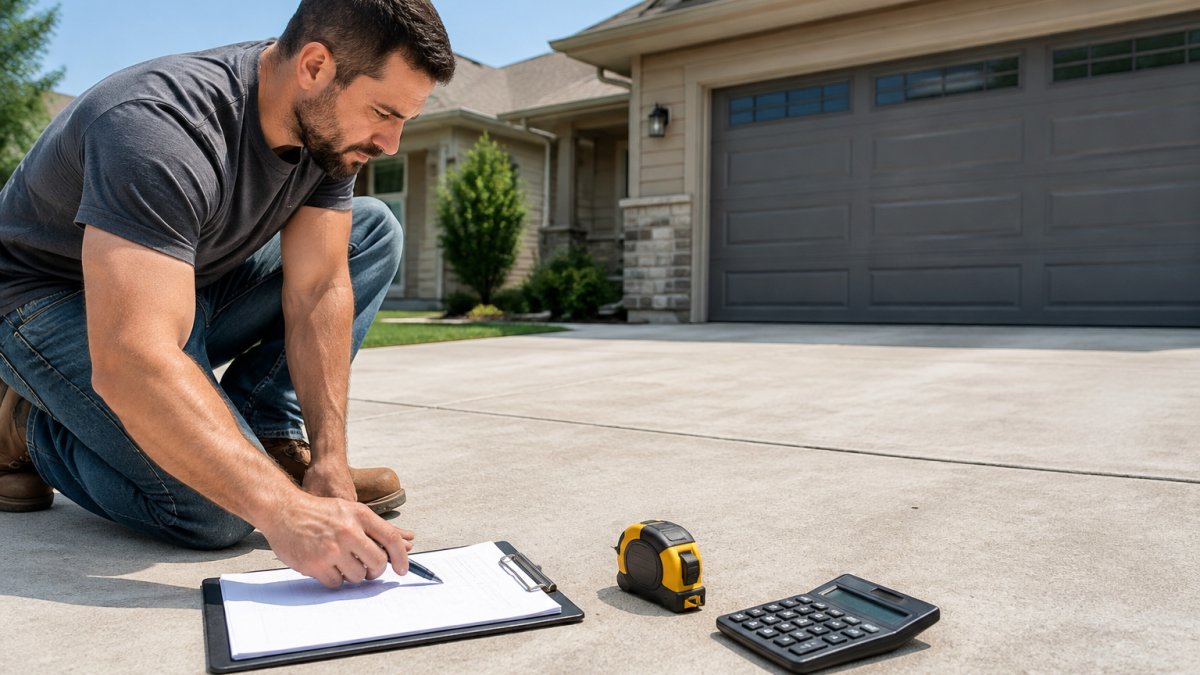
Measure your driveway before you call anyone. Length times width gives you square footage, and that number keeps every conversation honest.
Base Prep, Rebar, and Finish Choices
Base preparation is where cheap bids hide. Proper grading, compacted gravel, and reinforcement with rebar or wire mesh add cost up front and years to the slab's life. A broom finish is standard and slip-resistant; stamped concrete and decorative options raise the installed price.
Ask specifically what reinforcement the bid includes. "Concrete" is not a specification.
Concrete Driveway Removal Cost and What Tear-Out Involves
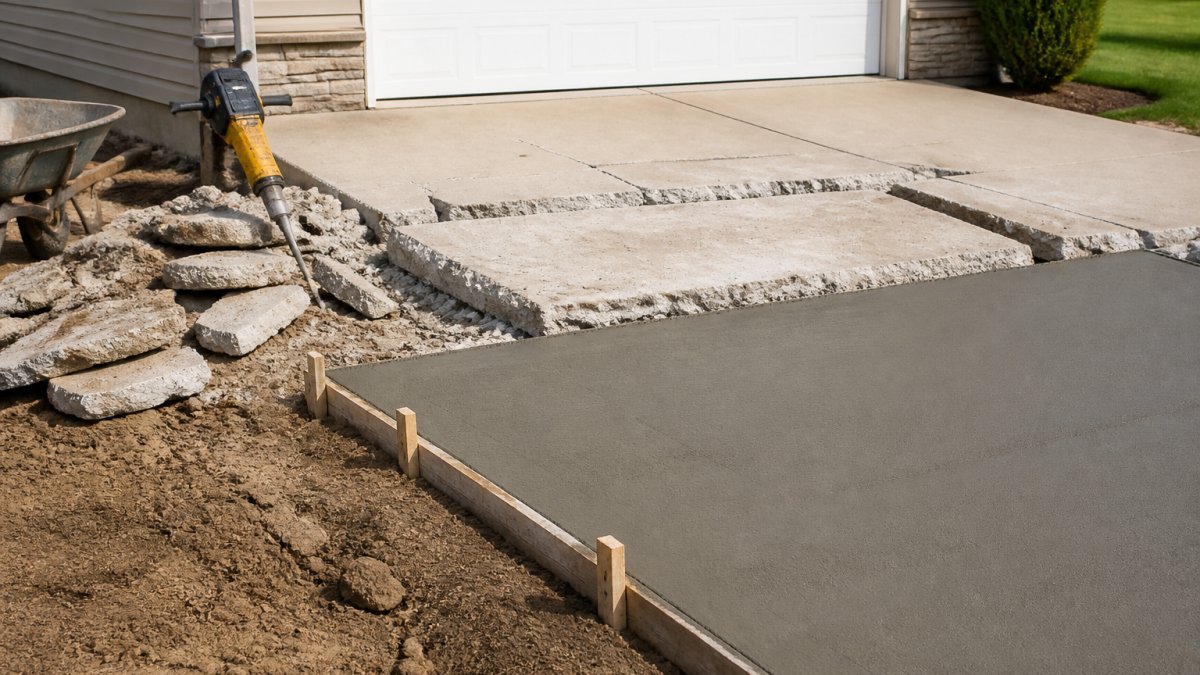
Concrete driveway removal cost depends on slab thickness, access, and how much hauling is required. Tear-out is not just breaking concrete. It means demolition, loading, haul away, and disposal fees at a licensed facility, plus protecting your lawn, landscaping, and any utilities running beneath.
Access matters more than most people expect. A crew with a full-size machine needs room to work. Tight lots, fences, and steep grades slow the job and raise labor costs.
Ask whether the bid includes dumpster fees and disposal. Some contractors itemize removal separately and surprise homeowners later.
Your Driveway Replacement Quote Checklist
A driveway replacement quote checklist keeps you from comparing apples to empty promises. Use these criteria to score every bid you receive, and reject any that cannot answer them in writing.
- Total square footage and slab thickness stated in inches
- Base depth and compaction method described
- Reinforcement type named: rebar size and spacing, or wire mesh
- Concrete mix strength specified
- Removal, haul away, and disposal fees included
- Site preparation and grading line item
- Control joints and drainage plan
- Finish type and any decorative options priced
- Permit responsibility stated
- Payment schedule and start date
- Warranty terms in writing
Line Items Every Itemized Bid Should Show
An itemized bid separates material costs, labor costs, and installation costs so you can see where the money goes. At minimum, expect separate lines for demolition, disposal, base preparation, reinforcement, concrete supply, finishing, and cleanup.
A single lump-sum number tells you nothing about value. Two bids can land within a few hundred dollars and still be wildly different in what they deliver.
Questions to Ask a Concrete Driveway Contractor Before You Sign
Ask about licensing, insurance, warranty, and the crew doing the work. Then ask what happens if the slab cracks. A contractor who answers those four clearly is usually a safe hire. But the answers only matter if you verify them, and most homeowners never do.
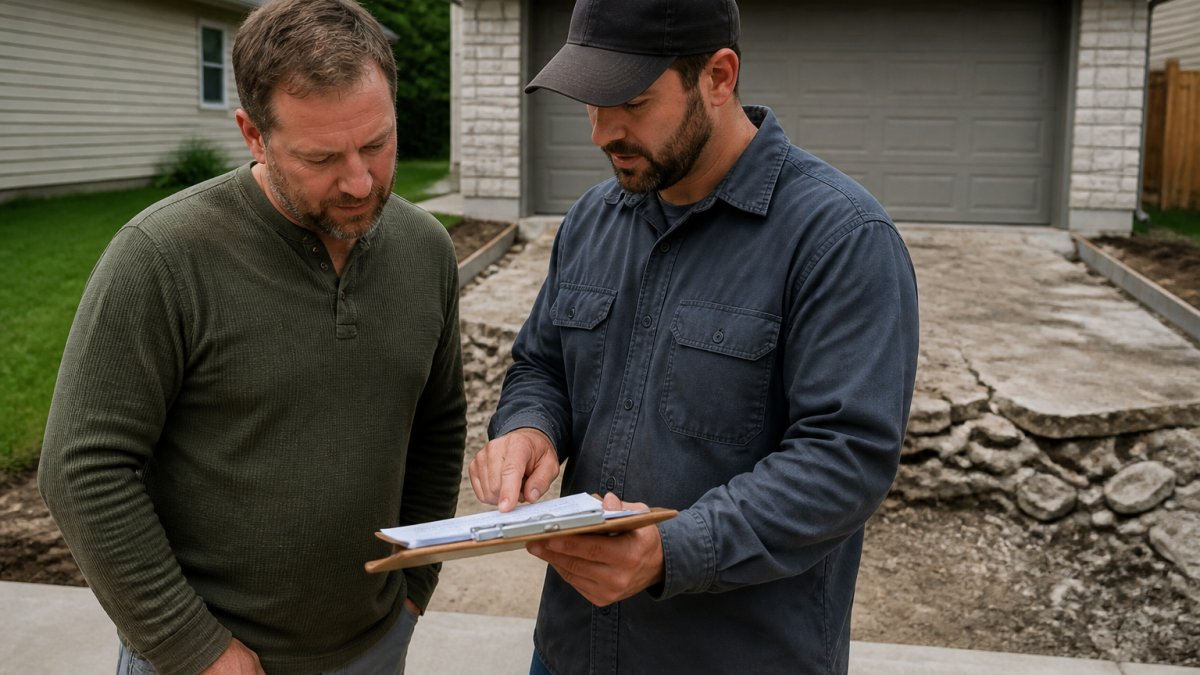
The Four Questions That Matter Most
Start with these, and write down the answers so you can compare contractors side by side:
- Are you licensed and insured, and can I see the certificate?
- Who actually pours the concrete, your crew or a subcontractor?
- What is your warranty, and does it cover cracking?
- How will you protect my lawn and drainage during tear-out?
Add two more that separate careful crews from fast ones: What is the project timeline, and what weather delays should I expect? And who is the on-site supervisor I can call if something changes?
How to Verify Licensing and Insurance
Do not accept a license number at face value. Ask for the number in writing, then confirm it with your state or local building authority. Most states maintain an online license lookup, and a legitimate contractor will not hesitate to give you the number.
For insurance, request a certificate of insurance that names you as certificate holder. Call the insurer's number on the certificate to confirm the policy is active and covers general liability and workers' compensation. If a crew member is injured on your property and the contractor has no workers' comp, the claim can follow you.
How to Check References and Past Work
Ask each contractor for two addresses of driveways they poured at least three years ago. Then drive past them. Look for cracking, settling at the edges, and drainage problems. A slab that has survived several freeze-thaw cycles tells you more than any brochure.
Call the references and ask three questions: Did the crew show up when promised? Was the final invoice close to the quote? Would you hire them again? A pattern of evasive answers is a warning sign.
Warranty and Crew Questions
Ask what the warranty covers and for how long. A warranty that covers cracking for one year is very different from one that covers structural failure for five. Get the terms in writing, including what voids the warranty, such as failure to cure the slab properly or driving on it too soon.
Finally, ask who will actually be on site. If the answer is a subcontractor, ask for that company's name and license, and confirm they carry their own insurance. The crew pouring your driveway should be identifiable before the truck arrives.
Repair or Replace? How to Read the Quote and Decide
Repair wins when damage is cosmetic and isolated: a few hairline cracks, a settled corner, surface scaling. Replacement wins when the slab is structurally failing, heaving, or crumbling across large sections, because patching a failing base wastes money. The hard part is knowing which situation you are in, and that is where a written quote becomes a diagnostic tool.
A Simple Decision Framework
Use these four checks before you accept a replacement bid:
- Crack width and pattern. Hairline cracks under about 1/8 inch are usually cosmetic. Cracks wider than 1/4 inch, or cracks that form a pattern across the slab, often signal base failure.
- Settlement and heaving. A corner that has dropped or a section that has risen out of line means the subgrade is moving. Patching the surface will not fix a moving base.
- Drainage. Water pooling against the slab or running toward the house is a drainage problem that replacement can correct and patching cannot.
- Extent of damage. If more than about a third of the slab is affected, replacement is usually more cost-effective than repeated repairs.
How to Read the Quote Against the Diagnosis
Read the quote against the diagnosis. If a contractor recommends full replacement, ask what specific defect requires it. If they recommend patching, ask how long the repair should last. A repair-versus-replace decision is really a question about the base. If the subgrade is sound, repair makes sense. If it has failed, no surface fix will hold.
Ask the contractor to show you the defect, not just describe it. A reputable crew will walk the driveway with you and point out the crack widths, settled areas, and drainage paths that drove the recommendation.
When Patching or Resurfacing Makes Sense
Patching is reasonable for isolated spalls, a single settled corner that can be mudjacked, or surface scaling that has not reached the reinforcement. Resurfacing, sometimes called an overlay, can buy time when the slab is sound but worn. Ask how long the repair should last and what conditions would push you toward replacement later.
Questions to Ask Before You Decide
- What specific defect makes replacement necessary?
- Could a repair last five years or more, and what would it cost?
- Does the replacement quote include correcting the drainage or base problem that caused the damage?
- What happens if the new slab shows the same problem within the warranty period?
A contractor who cannot answer those questions in writing is asking you to spend replacement money on a guess.
Contract Terms, Payment Schedule, and Post-Pour Care
Never pay the full amount up front. A standard schedule ties payments to milestones: a deposit at signing, a progress payment after tear-out and base prep, and the balance after final cleanup and your walkthrough.
Change orders should be written and signed before extra work starts. Verbal "we'll add that in" arrangements are how budgets balloon.
After the pour, concrete needs curing time. Keep vehicles off the new slab for the period your contractor specifies, typically about a week, and longer for heavy trucks. Water it as directed in hot weather, and avoid de-icing salts the first winter.
Getting a concrete driveway replacement quote should not feel like a gamble. The homeowners who come out ahead are the ones who demand itemized bids, verify credentials, and lock terms in writing before a single truck arrives.
Frequently Asked Questions
What should a concrete driveway replacement quote include?
A solid quote breaks the job into line items: square footage and slab thickness, concrete mix and cubic yardage, rebar or wire mesh, tear-out and haul-away of the old slab, base preparation and grading, forming, finish type, control joints, and cleanup. It should also list permits, the payment schedule, and the warranty in writing. If a bid is one lump sum with no breakdown, ask for an itemized version before you compare it to anything else.
Should I get multiple quotes for a concrete driveway replacement?
Yes. Three written quotes give you a real benchmark, because concrete driveway replacement cost varies with slab size, access, and how much tear-out is involved. Compare line by line rather than by the bottom number. A bid that is far cheaper often skips base prep, reinforcement, or proper disposal. Ask each contractor to quote the same thickness and finish so the numbers are actually comparable.
How long does it take to replace a concrete driveway?
Most residential replacements take two to four days of active work: tear-out and hauling, grading and base prep, forming and rebar, then the pour and finish. Plan on staying off the new slab for about seven days before driving on it, and longer before heavy trucks. Weather, permit timing, and site access can stretch the schedule, so get the timeline written into the quote.
Can I lock in a price before the work starts?
Ask for a fixed-price quote after an on-site estimate, not just a phone ballpark. A site visit lets the contractor confirm access, subgrade condition, and drainage, which are the variables that cause prices to move. Put the agreed scope and price in the contract, and require written change orders for anything added later. That protects you from surprise increases once the crew is on your property.