 listicle
How Do You Choose Commercial Flatwork Contractors in Kansas City?
Last Updated: October 30, 2026
Quick Summary
Choose commercial flatwork contractors in Kansas City by verifying commercial capability before you shortlist: ask each bidder for their largest single pour, equipment owned versus rented, crew depth, and references from active commercial sites. Then require itemized bids against one identical scope baseline so you compare assumptions, not just totals.
- Commercial flatwork covers parking lots, loading aprons, sidewalks, dumpster pads, and curbs and gutters on grade.
- Ask bidders for their largest single pour with project address and date.
- Curing commonly takes about 7 days for working strength and 28 days for design strength.
- Build a five-item scope baseline covering area, surface condition, drainage, access, and permits.
- Confirm in writing who pulls permits and who pays for inspections before awarding.
Table of Contents
- What Commercial Flatwork Contractors in Kansas City Actually Deliver
- Quick Comparison: Kansas City Commercial Flatwork Contractors
- What Drives Commercial Concrete Project Cost in Kansas City
- Concrete Site Preparation and Grading: The Step That Decides Longevity
- Commercial Concrete Curing Time and What It Means for Your Schedule
- Choosing Concrete Parking Lot Contractors for Large Pours
- Permits, Codes, and Safety on Commercial Concrete Jobs
- Calculate Your Job Estimate Before You Request Bids
- Frequently Asked Questions
What Commercial Flatwork Contractors in Kansas City Actually Deliver
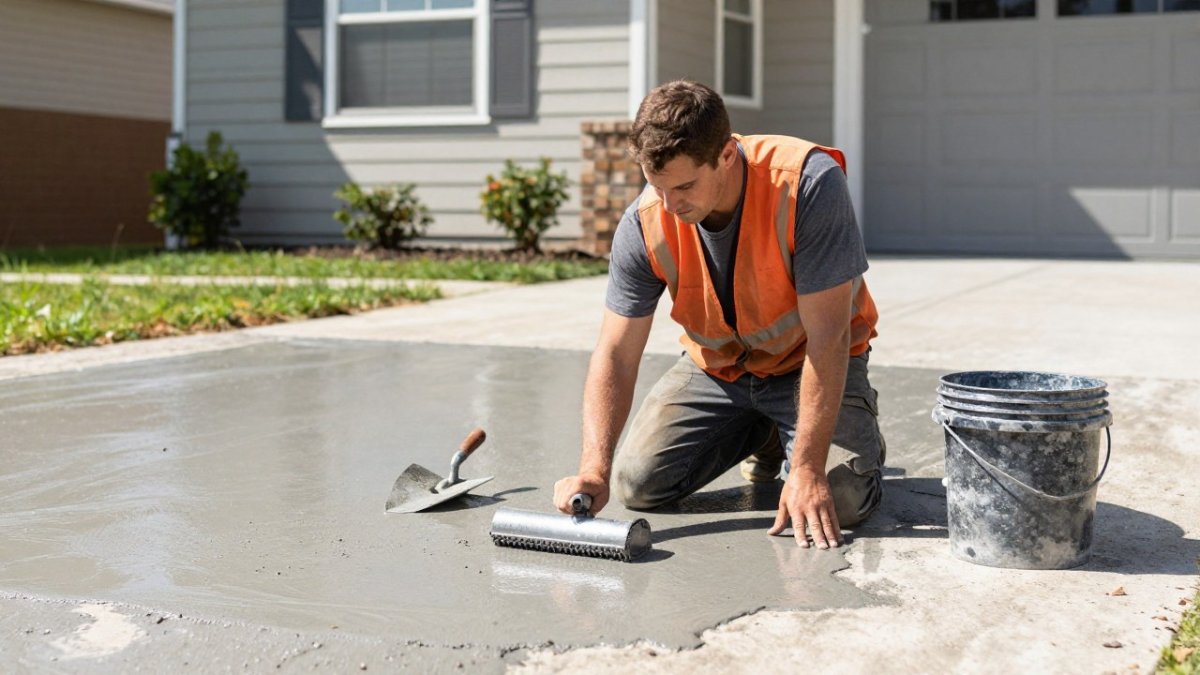
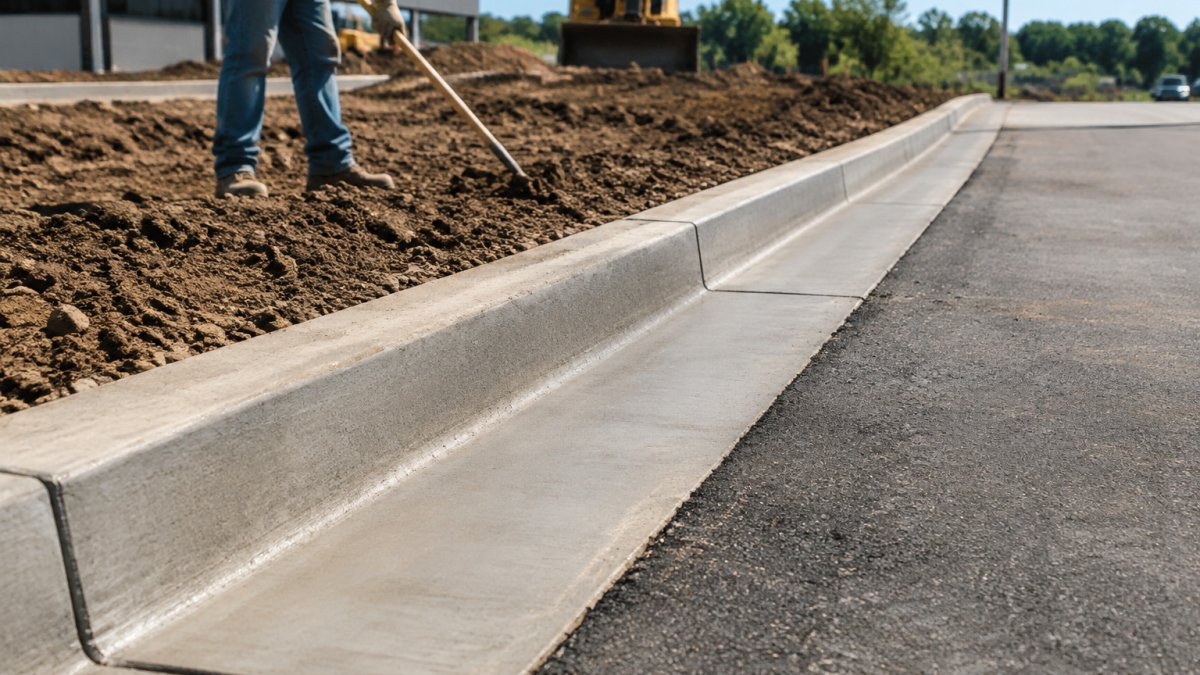
Hiring commercial flatwork contractors Kansas City property owners can rely on starts with knowing what the trade actually covers. Commercial flatwork is the poured, finished concrete that sits on grade around a building: parking lots, loading aprons, sidewalks, dumpster pads, and curbs and gutters.
Below, we break down how to compare contractors, read a bid, and estimate scope before anyone shows up on site.
Flatwork, Structural Concrete, and Where the Line Sits
The distinction is simple: flatwork is concrete placed horizontally and finished for traffic or drainage. Structural concrete carries a building's load through footings, grade beams, and tilt-wall panels.
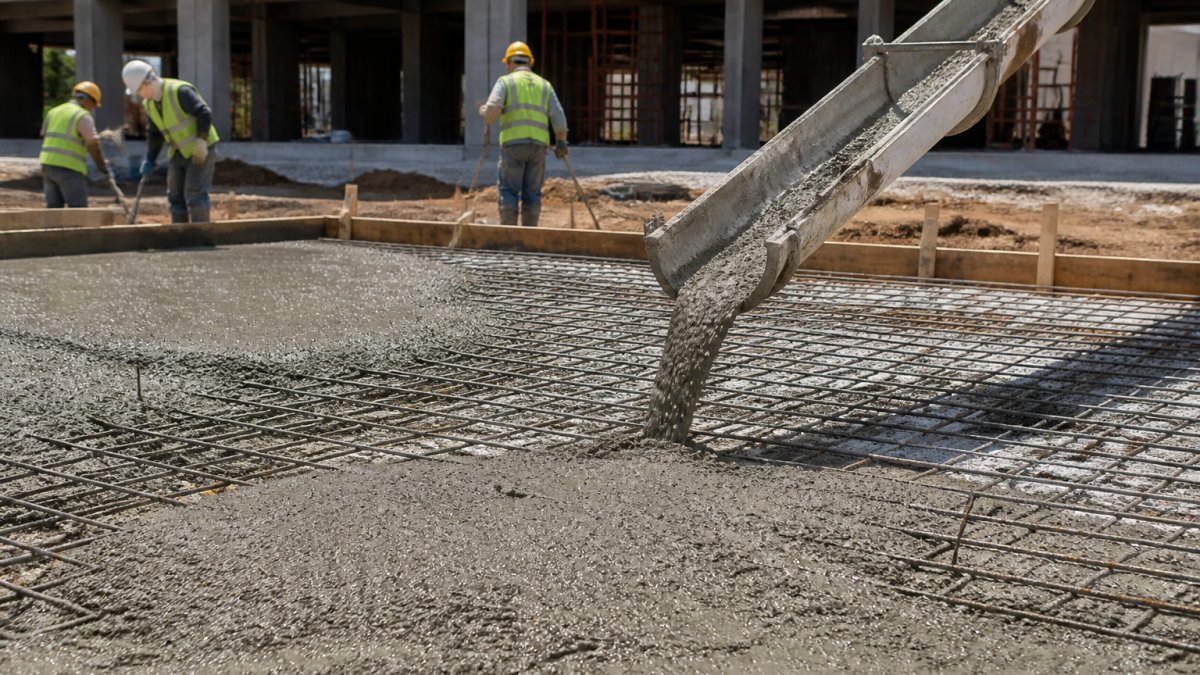
Flatwork crews focus on subgrade compaction, form setting, joint layout, and finish. Structural crews deal with rebar cages, embed plates, and engineering specs. For the structural side of that line, see this guide to commercial foundation concrete pouring services.
Quick Comparison: Kansas City Commercial Flatwork Contractors
Treat the comparison below as a starting point for verification, not a ranking.
| Contractor | Core Focus | Commercial Evidence to Request | Self-Perform Scope | Pricing Visibility | Best For |
|---|---|---|---|---|---|
| BK Concrete LLC | Commercial and residential flatwork, foundations, curbs | Parking lot and loading area references; largest single pour | Site prep through finish | Online ballpark estimator | Owners who want one crew from grading to cure |
| MegaKC | Commercial concrete and flatwork | Commercial project list with square footage and pour dates | Reports a high self-perform rate | Contact for pricing | Teams prioritizing self-performed work |
| K&E Flatwork | Flatwork, paving, concrete repair | Repair and paving scopes on active commercial sites | Not specified | Contact for pricing | Repair and paving-heavy scopes |
| Amino Brothers Co. | Mass excavation and flatwork | Sites where excavation and flatwork were coordinated | Not specified | Contact for pricing | Sites needing excavation plus flatwork |
| Whistle Redi-Mix | Concrete supply | Mix designs and delivery capacity for large pours | Supplier, not contractor | Not listed | Sourcing ready-mix, not installation |
How to Verify Commercial Capability Before You Shortlist
A contractor's homepage is not evidence of commercial capacity. Ask every bidder for the same four items and compare the answers side by side:
- Largest single pour: cubic yards placed in one continuous pour, with the project address and date.
- Equipment owned versus rented: laser screeds, riding trowels, curb machines, and compaction equipment. Rental is fine, but a bidder who owns the core equipment controls schedule and quality better on tight timelines.
- Crew depth: number of finishing crews and whether they can run parallel pours or phased work without pulling from residential jobs.
- Active-site experience: references from projects where the property stayed open, deliveries were sequenced, and the contractor coordinated with a general contractor or facility manager.
What the Comparison Does Not Tell You
A table cannot show subgrade conditions, access constraints, or spec differences that drive most of the price spread. Two bidders can look identical on paper and be thousands of dollars apart because one assumed over-excavation and the other did not. Use the table to build a shortlist, then compare itemized bids against an identical scope, covered in the estimate section below, before you sign anything.
What Drives Commercial Concrete Project Cost in Kansas City
Commercial concrete project cost comes down to five variables: square footage, slab thickness and reinforcement, subgrade condition, joint and drainage detail, and site access. Thicker slabs with rebar cost more in material and labor. Poor subgrade means over-excavation and haul-off, which is often the single biggest surprise line on a bid.
Pricing depends on quantity, site conditions, and specifications. To keep those variables from turning into mid-project increases, see how to avoid concrete contractor price escalation. For current pricing or a quote, visit the BK Concrete LLC website.
How to Read a Bid Line by Line
A credible bid separates these items instead of lumping them:
- Subgrade preparation and compaction, with a stated depth
- Haul-off and disposal of unsuitable soil
- Formwork and joint layout
- Reinforcement type and spacing
If a line says "concrete work, lump sum," ask for the breakdown.
Concrete Site Preparation and Grading: The Step That Decides Longevity
Concrete site preparation and grading play a major role in how a slab performs. Compaction, drainage slope, and a stable subbase are important, and a slab poured over soft fill is at risk regardless of the mix.
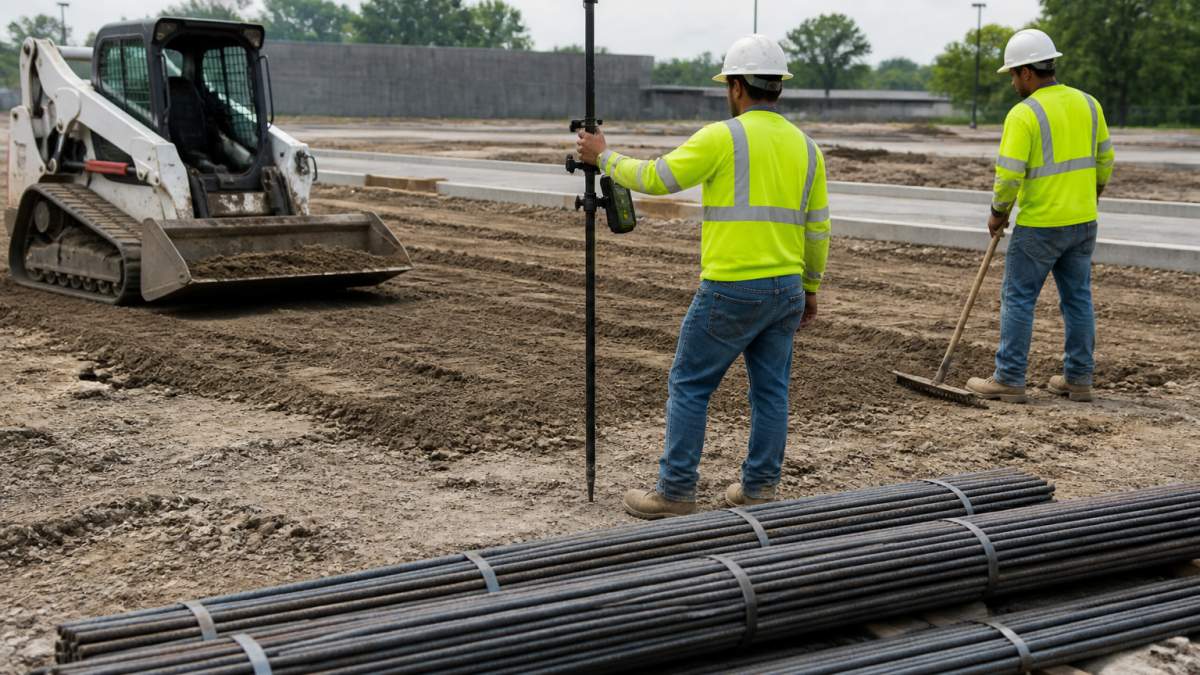
Ask for compaction documentation before the pour, not after.
Commercial Concrete Curing Time and What It Means for Your Schedule
Commercial concrete curing time is commonly cited as about 7 days to reach working strength and 28 days to reach design strength, though weather and mix design shift those numbers. Cold weather slows curing, and hot, windy weather can dry the surface too fast.
Plan around cure time rather than fighting it. Traffic typically stays off new flatwork for at least a week, and heavy loads wait longer. Finish selection also affects durability and timing, which our guide on choosing the most durable concrete finish covers in detail.
Choosing Concrete Parking Lot Contractors for Large Pours
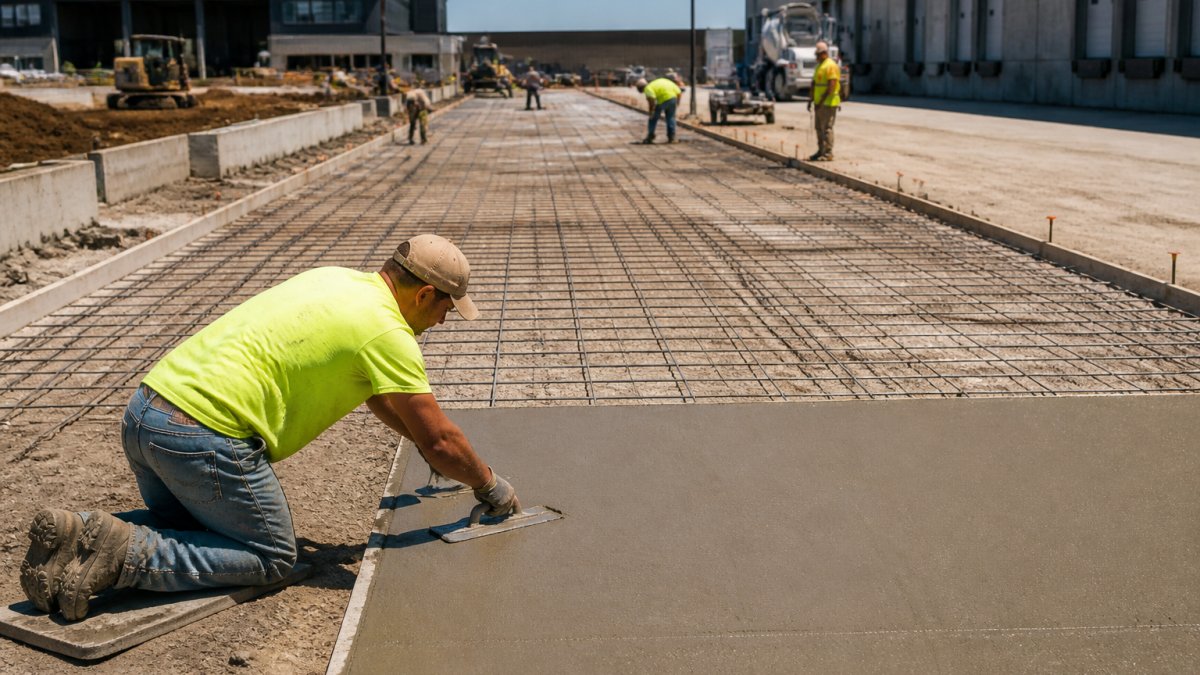
Concrete parking lot contractors for large pours need three things smaller crews often lack: equipment capacity, crew depth, and pour scheduling experience. A large lot is not a scaled-up driveway. It requires equipment and crew capacity sized to the pour.
Ask any bidder three questions: How many cubic yards did your largest single pour involve? What equipment do you own versus rent? How do you handle a truck that arrives late? As the American Concrete Institute notes in its guidance on jointing and placement, cold joints and poor joint layout are leading causes of premature slab failure.
Permits, Codes, and Safety on Commercial Concrete Jobs
Permits and code compliance on commercial concrete jobs fall to the contractor, not the property owner, in most scopes. Grading, stormwater, and right-of-way work touch local codes, and accessibility requirements for parking and paths fall under the ADA Standards for Accessible Design. Confirm in writing who pulls permits and who pays for inspections.
Calculate Your Job Estimate Before You Request Bids
Commercial flatwork bids are easier to compare when every bidder prices against the same scope baseline. Building that baseline before you call contractors is a practical first step.
Build a Five-Item Scope Baseline
Walk the site and record these five items. They are enough to sanity-check any bid and to force bidders onto the same assumptions:
- Area and thickness: measure square footage and note specified slab thickness (4, 5, 6 inches, etc.). Thickness drives concrete volume and cost more than any other single variable.
- Existing surface condition: photograph cracks, joint spalling, drainage failures, and any areas that need removal versus overlay. Removal and haul-off are frequently underestimated.
- Drainage direction and slope: note where water currently goes and where it should go. Poor drainage is a common cause of premature flatwork failure and a common bid exclusion.
- Access width and truck routing: measure gate widths and turning radii. Limited access means smaller loads, more trips, and higher cost.
- Permit and inspection responsibility: confirm in writing who pulls permits and who pays for inspections. This line alone can swing a bid by thousands of dollars.
Normalize Every Bid Against the Same Line Items
Require each bidder to break the quote into the same categories so you can compare apples to apples:
- Subgrade preparation and compaction, with a stated depth
- Over-excavation and haul-off of unsuitable soil, priced per cubic yard
- Formwork and joint layout
- Reinforcement type and spacing (rebar size, mesh, or fiber)
If a line says "concrete work, lump sum," ask for the breakdown. A bid that cannot be broken down cannot be compared, and it usually means the contractor is either guessing or planning to escalate later.
The Five Cost Drivers That Explain Most of the Spread
When bids differ, the gap is often driven by one or more of these items:
- Square footage and thickness: the base volume calculation.
- Reinforcement: rebar versus mesh versus fiber changes material and labor.
- Subgrade condition: soft fill means over-excavation and haul-off, often the largest surprise line.
- Joint and drainage detail: more joints and drainage structures mean more labor and materials.
A Simple Bid-Comparison Checklist
Before you award, confirm each bidder has answered these in writing:
- Does the bid state compaction depth and testing requirements?
- Is over-excavation priced per cubic yard, or excluded?
- Are permits and inspections included or excluded?
- Is the concrete mix design and thickness specified?
- Is there a stated contingency and a trigger for using it?
Comparing bids against an identical scope is the only fair contractor comparison. Bids that differ wildly usually reflect different assumptions, not different prices. As the National Ready Mixed Concrete Association points out, mix design and thickness assumptions drive cost far more than the concrete itself.
Frequently Asked Questions
What does commercial concrete flatwork include?
Commercial flatwork covers ground-level concrete pours: parking lots, loading aprons, sidewalks, drive lanes, dumpster pads, and building slabs. It usually includes site preparation and grading, forming, rebar or mesh reinforcement, pouring, finishing, and joint cutting. Structural work such as tilt-wall foundations and footings is a separate scope, so confirm which side of that line a contractor handles before you sign. Ask for the specific square footage and slab thickness in writing.
How do I choose a commercial flatwork contractor in Kansas City?
Start with three checks: how much of the work the company self-performs, whether it has poured projects at your square footage, and whether the bid itemizes excavation, reinforcement, and curing. A contractor that self-performs most of its concrete work controls the schedule instead of waiting on a subcontractor. Ask for project addresses you can drive past, then compare at least two itemized bids on the same scope so the numbers are actually comparable.
What affects commercial concrete project cost?
Square footage and slab thickness set the base, then site conditions add to it: poor soil, slope, demolition of old concrete, and limited access for trucks all raise the number. Reinforcement type, joint layout, decorative finishes, and permit fees add cost too. Because pricing depends on project scope, soil, and access, get an itemized bid rather than a single lump sum, and ask what conditions would trigger a change order.
How long does a commercial concrete project take?
Site preparation and grading typically take a few days on a mid-size lot, the pour itself usually happens in one day, and commercial concrete curing time runs about 7 days before light traffic and roughly 28 days to reach design strength. Weather, inspection scheduling, and crew size move those windows. Ask the contractor for a day-by-day schedule that names inspection dates, and confirm when the lot can take delivery trucks versus passenger vehicles.
How thick should commercial concrete paving be?
Thickness depends on what drives on it. Standard commercial parking areas commonly run 5 to 6 inches, while drive lanes and areas with heavy truck traffic often call for 7 to 8 inches with heavier reinforcement. Your contractor should size the slab from the expected axle loads and soil conditions, not from a default number. Ask for the thickness and reinforcement spec in writing and confirm it appears on the permit drawings.
Commercial concrete work rewards the owner who asks hard questions before the pour, not after the first crack appears. BK Concrete LLC handles site preparation, grading, rebar reinforcement, and precision curb and gutter pouring to city specifications, and our online estimator gives you a quick ballpark on material and labor before you commit. Calculate a job estimate with BK Concrete LLC and start your project with a scope you understand.