 how-to
How to Verify a Concrete Contractor Warranty Before You Sign
Last Updated: November 15, 2026
Quick Summary
To verify a contractor warranty, get the full written document before paying a deposit and confirm the legal business name on it matches your contract. Check the coverage period, exclusions, claim process, and signature from a company officer, then verify the contractor's license and insurance yourself.
- A warranty signed by a salesman is not a company warranty; get an officer's signature.
- Workmanship and product warranties are backed by different parties with different claim processes.
- Test each exclusion for specificity, disclosure, and conflict with your contract.
- If a warranty fails three or more template rows, walk away.
- Keep project photos, maintenance receipts, and dated problem photos for any claim.
Table of Contents
- Read the Written Warranty Before You Sign Anything
- Confirm Who Actually Backs the Contractor Warranty
- Typical Concrete Contractor Warranty Period and What It Covers
- Concrete Warranty Exclusions That Void Your Coverage
- Real Concrete Warranty Examples and a Concrete Warranty Template to Compare
- How to Submit a Warranty Claim With Documentation and Photos
- Get Your Warranty Terms in Writing From BK Concrete LLC
- Frequently Asked Questions
Read the Written Warranty Before You Sign Anything
Learning how to verify concrete contractor warranty terms starts with one rule: get the document before the deposit. A concrete warranty is a written promise from the contractor to repair or replace defective work within a set period. Without paper, you have nothing to enforce.
Read the warranty before you read the estimate. The warranty often matters as much as the price.
Why? Because a driveway, patio, or stamped concrete slab is a long-term purchase. Repairs are expensive. A weak warranty can cost you more than a cheap quote ever saves.
So before you sign, slow down. Ask for the full warranty document. Read it at your kitchen table, not in a contractor's truck.
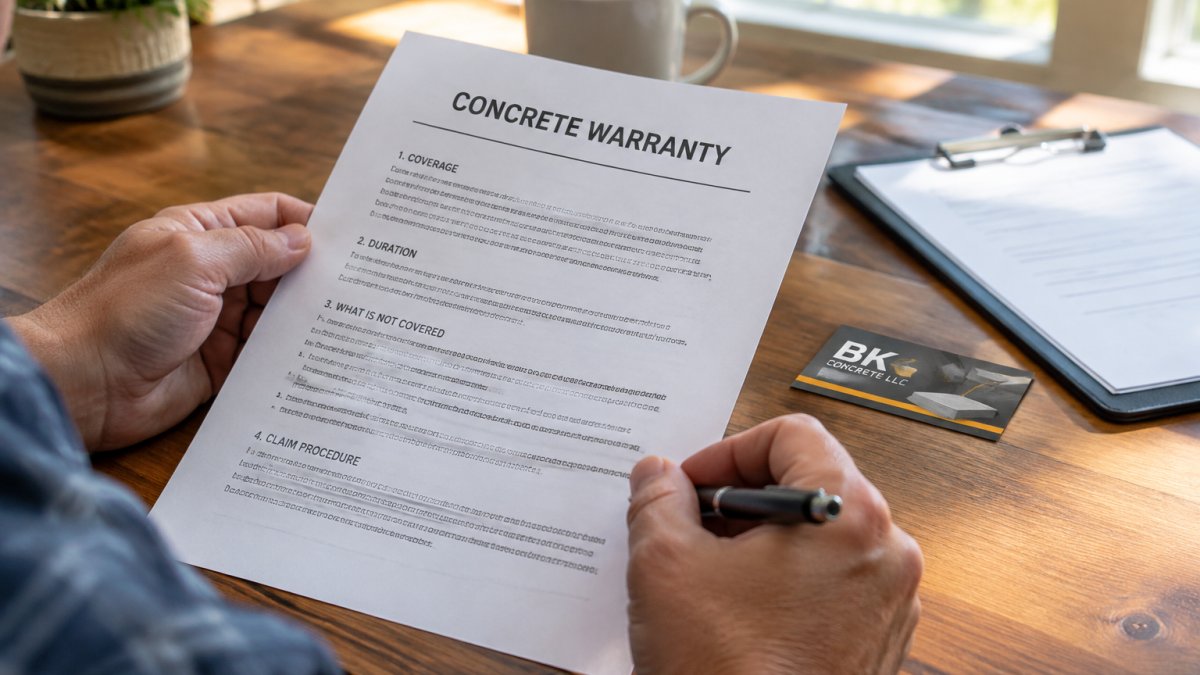
The Checklist for Verifying Warranty Documentation
Use this checklist before you sign anything. Print it and take it to every meeting.
- Written warranty is a separate document, not a verbal promise
- Contractor's legal business name appears on the warranty
- Coverage period has clear start and end dates
- Workmanship and materials are both addressed
- Exclusions are listed in plain language
- Claim process and deadline are spelled out
- Signature line for the contractor, not just for you
- Warranty transfers if you sell the property
If any box stays empty, ask why. A contractor who cannot produce a written warranty on request is telling you something important.
Confirm Who Actually Backs the Contractor Warranty
The name on the warranty must match the name on your contract. That sounds obvious. It is also the most common gap we see. But matching names is only the first step. You also need to know which kind of warranty you are holding, because a concrete project can carry two very different promises.
Workmanship warranty vs. product warranty
A workmanship warranty is the contractor's promise that the labor, grading, forming, placing, finishing, curing, jointing, was done correctly. A product warranty is the material supplier's promise that the concrete mix, sealer, or reinforcement met its published specifications. They are backed by different parties, have different claim processes, and often have different durations.
Homeowners often conflate the two and file a claim with the wrong party. Before you sign, ask the contractor to identify, in writing:
- Which parts of the warranty are workmanship, and which are product.
- The legal name of the company or individual backing each one.
- The supplier's warranty document, if a product warranty is included.
- Whether the contractor will act as your point of contact for a supplier claim.
Verify the issuer, not just the signature
A warranty signed by a salesman is not a company warranty. Get the signature from an officer or authorized representative of the legal entity named on your contract. Then verify that entity yourself:
- Ask for the contractor's legal business name, license number, and certificate of insurance in writing.
- Confirm the license through your state's contractor licensing board lookup, where one exists.
- Confirm general liability and workers' compensation coverage by calling the insurer listed on the certificate, not the agent's phone number on the contractor's letterhead.
- Check complaint history through the Better Business Bureau and your state attorney general's consumer protection office.
Watch out: a warranty that names an individual owner rather than the company may not survive a sale, retirement, or entity change. Ask directly: "If you sell the business or retire, who honors this warranty, and is that commitment written into the document?"
Confirm the manufacturer side
If the warranty includes product coverage, ask for the supplier's written warranty and read its exclusions. Product warranties commonly exclude damage caused by improper installation, which means the supplier may deny a claim the contractor should have covered. Keep both documents in the same folder so you can tell which party is responsible when a problem appears.
Typical Concrete Contractor Warranty Period and What It Covers
Warranty length varies by contractor and project, and materials coverage depends on the supplier.
Here is what a solid concrete warranty typically covers:
- Major cracking beyond normal hairline cracks
- Scaling and spalling from defective finishing or mix
- Settlement that causes trip hazards or ponding
- Workmanship defects in grading, forms, and joints
What it usually does not cover: color variation, texture variation, surface stains, and damage from deicing salts or heavy loads. Those are normal conditions, not defects. Ask your contractor to explain each exclusion in person so nothing surprises you later.
Concrete Warranty Exclusions That Void Your Coverage
Concrete warranty exclusions are where most claims die. Read them twice, then test them against the rest of your paperwork. An exclusion is only enforceable if it is specific, disclosed before signing, and consistent with the contract and applicable state consumer protection law.
Common exclusions and conditions that void coverage
- Failure to follow concrete care and maintenance instructions
- Vehicle loads beyond the slab's design
- Damage from chemicals, salt, or tree roots
- Cracking the contractor classifies as cosmetic
- Work altered by another contractor
- Claims filed after the deadline
Watch out: skipping a required sealer application or ignoring cure instructions can void your warranty on paper, even if the crack has nothing to do with it. Follow the maintenance schedule your contractor gives you, and keep receipts.
How to test whether an exclusion is enforceable
Run each exclusion through these checks before you sign:
- Is it specific? "Damage from deicing salts" is specific. "Damage from misuse" is a catch-all that can swallow the whole warranty.
- Is it disclosed? An exclusion buried in a document you never received before signing is weaker than one you initialed.
- Does it conflict with the contract? If the contract promises a defect-free slab but the warranty excludes the most common defect, the two documents conflict. Ask which controls.
- Is the claim window reasonable? A 30-day claim window on a defect that may take a year to appear is a red flag. Ask for the window in writing and compare it to the coverage period.
- Is it verbal or written? A verbal promise to "take care of it" is not a warranty. Get every assurance into the signed document.
- Does state law override it? Many states limit how far a warranty can disclaim implied warranties or require specific notice language. Your state attorney general's consumer protection office and your state contractor licensing board publish guidance on contractor obligations; check both before you assume an exclusion is final.
Red flags that should stop the signing
- "Lifetime" coverage with no definition of lifetime
- Broad catch-all clauses that exclude "all cracking" or "all surface defects"
- A claim deadline shorter than the coverage period
- No written claim process
- Terms that contradict the estimate or contract you already signed
- No signature from the company
If a warranty fails three or more of these checks, ask the contractor to revise it in writing. A contractor who will not put clear terms on paper is telling you how a future claim will go.
Real Concrete Warranty Examples and a Concrete Warranty Template to Compare
Ask for concrete warranty examples from recent jobs. A serious contractor will share redacted copies without hesitation. Compare them side by side.
Use this template as your benchmark when you review a contractor warranty:
| Section | What Good Looks Like | Red Flag |
|---|---|---|
| Coverage period | Clear start and end dates | "Lifetime" with no definition |
| Workmanship | Repair or replacement stated | Vague "will address" language |
| Exclusions | Itemized and explained | Broad catch-all clauses |
| Claim process | Written steps and deadline | "Call us and we'll see" |
| Transferability | Transfers to new owner | Ends at sale |
| Signature | Company officer signs | No signature at all |
If a warranty fails three or more rows, walk away. For a closer look at how fixed-price terms should be structured, see our guide on fixed price concrete quotes.
How to Submit a Warranty Claim With Documentation and Photos
A warranty claim succeeds or fails on documentation. Start a folder the day work finishes.
Keep these records:
- Signed contract and warranty document
- Project photos from each stage, especially the completion date
- Maintenance receipts, including sealer purchases
- Dated photos of the problem, taken in good light
- A written description of the issue and when it appeared
Then follow the claim submission steps in your warranty. Most require written notice within a set window. Send it by email or certified mail so you have proof.
If the contractor disputes the claim, ask for an inspection in writing. If cracking appears early, our article on why concrete driveways crack early explains what counts as a defect versus a normal exclusion.
Get Your Warranty Terms in Writing From BK Concrete LLC
Verifying a contractor warranty takes an afternoon. Skipping it can cost you a driveway.
At BK Concrete LLC, we put warranty terms in writing before work starts. BK Concrete LLC handles site preparation, grading, and rebar reinforcement, and offers an online cost estimator for a quick ballpark before you commit.
Before you hire anyone, confirm their permits are in order. Our guide to Kansas City concrete permit requirements explains what permitted, warrantable work should include. If you are still deciding between a specialist and a middleman, read the benefits of hiring direct concrete specialists. And when you are ready, request a concrete project quote with written warranty terms attached.
A warranty is only as good as the contractor behind it. Ask for the document, check the name, and read the exclusions before you sign. BK Concrete LLC provides written warranty terms, full site preparation, and precision curb and gutter pouring to city specifications on every job. Get started with BK Concrete LLC and protect your concrete investment from day one.
Frequently Asked Questions
What is the typical warranty period for concrete work?
Warranty periods vary by contractor, and some cover structural work for longer than others. The period usually starts on the completion date listed in your written contract, not the day you first notice a problem. Ask the contractor to state the start date and the end date in writing, and confirm whether the warranty transfers if you sell the property. A warranty under a year deserves a hard look, since many defects such as major cracking and settling show up after the first freeze-thaw cycle.
Are concrete contractors required to warranty their work?
No federal law requires a concrete contractor to offer a warranty, and most states do not mandate one either. What you get is whatever the written contract says, which is why the document matters more than a verbal promise. If a contractor refuses to put warranty terms in writing, treat that as a red flag. Your leverage comes from state consumer protection rules and implied warranty law, but those are harder to enforce than a clear written warranty with a named issuer and a claim process.
Can a concrete warranty cover cracking or settling?
It depends on how the warranty defines the defect. Hairline cracking is usually excluded as normal, while major cracking, scaling, and spalling are often covered if they trace back to workmanship or materials. Settling is typically covered only when it results from poor subgrade preparation or inadequate compaction, not from soil conditions the contractor disclosed. Read the standard of repair section carefully: some warranties promise replacement, others only repair, and a few cap the payout at the original contract price.
What exclusions should you look for in a concrete warranty?
Watch for exclusions covering damage from deicing salts, vehicle loads beyond the design, tree roots, utility work, and failure to follow the contractor's concrete care instructions. Many warranties also void coverage if anyone other than the original contractor performs repairs. Check whether the warranty requires you to submit a claim within a set deadline, often 30 days of discovery, and whether it demands written documentation and photos. Exclusions buried in fine print are the most common reason claims get denied.