 how-to
5 Reasons Rebar Matters in Driveways
Table of Contents
- Why Concrete Needs Reinforcement
- How Rebar Strengthens a Concrete Driveway
- Does a Concrete Driveway Need Rebar?
- Rebar Size for Concrete Driveways
- Rebar Spacing for a Driveway Slab
- Rebar vs. Wire Mesh for Driveways
- Booking Your Driveway Pour With BK Concrete
- Frequently Asked Questions
Why Concrete Needs Reinforcement
Last Updated: October 28, 2026
Concrete handles squeezing forces very well, but it is weak when it is pulled or bent. A driveway that carries cars, trucks and delivery vans is constantly flexing a little under that weight, and that is where cracks begin.
Reinforcement is steel placed inside the slab to carry tensile forces that the concrete alone cannot handle. Rebar is the most common form, but wire mesh and fiber are used too. Each option works differently, and the right choice depends on the job.
Here is why reinforcement matters on most driveways:
- Vehicle loads shift over time. Repeated weight makes small bends in the slab.
- Temperature changes cause movement. Concrete expands and contracts as the weather shifts.
- Soil settles unevenly. Ground beneath the slab rarely stays perfectly even for years.
Without reinforcement, these forces tend to pull a slab apart along weak lines. With rebar in place, the steel holds the concrete together so small cracks stay tight instead of splitting the slab.
It is important to be clear about what rebar does and does not do. Rebar controls how cracks open and spread. It does not stop concrete from cracking altogether. Most slabs will still develop some cracking, so joints and proper curing matter too.
How Rebar Strengthens a Concrete Driveway
Rebar strengthens a driveway by sharing the tension load across the entire slab. Steel bonds tightly to concrete, so the two materials work together as one unit in rebar driveways.
When a heavy vehicle rolls over a slab, the bottom of the concrete is pulled in tension. Rebar placed near the bottom of the slab takes up that pull. This keeps a small crack from growing into a split.
Does a Concrete Driveway Need Rebar?
Consider rebar essential if your driveway:
- Gets regular use from trucks, RVs, or work vans
- Sits on soil that is clay-heavy or prone to shifting
- Connects to a garage slab or sits near a retaining wall
- Covers a long span without a control joint
If you are unsure, talk with a concrete professional about the load and soil at your site. Local conditions often decide the answer.
Rebar Size for Concrete Driveways
| Rebar Size | Diameter | Typical Driveway Use |
|---|---|---|
| #3 | 3/8 inch | Light-duty patios and small slabs; rarely specified for vehicle traffic |
| #4 | 1/2 inch | Standard residential driveways, 4- to 5-inch slabs |
| #5 | 5/8 inch | Heavy-use driveways, thicker slabs, or poor soil |
How slab thickness and load change the answer
Size and thickness are a package. A 4-inch slab with #4 bar at 24 inches on center is a common light-duty specification. Step up to a 5- or 6-inch slab for trucks, RVs, or frequent delivery traffic, and #4 or #5 bar at 18 inches on center becomes more typical. Putting #5 bar in a thin slab does not automatically make it stronger, the steel needs enough concrete around it to bond and to provide cover.
What the code and the plan should say
The International Residential Code (IRC) and local amendments set minimums for slab reinforcement, and many jurisdictions require a permit for driveway flatwork. The approved plan should list bar size, spacing, and slab thickness. If the plan is silent, ask the contractor to specify it in writing before the pour. A verbal "we'll use #4" is not a specification.
Common sizing mistakes
- Using mesh as a substitute without checking the plan. Wire mesh is lighter and can sag; it is not a one-for-one swap for #4 bar in a driveway that sees daily vehicle traffic.
- Oversizing without adding cover. Larger bars need more concrete around them. If the slab is thin, the steel ends up too close to the surface and rusts.
- Mixing sizes without a reason. A uniform grid is easier to place correctly and easier to inspect.
Rebar Spacing for a Driveway Slab
Local codes often set minimums. The International Residential Code (IRC) and many state or municipal amendments address slab reinforcement for driveways and other flatwork, and some jurisdictions require a permit and inspection before the pour. Ask your contractor which code edition and local amendments apply to your address, and get the spacing and bar size in writing on the plan.
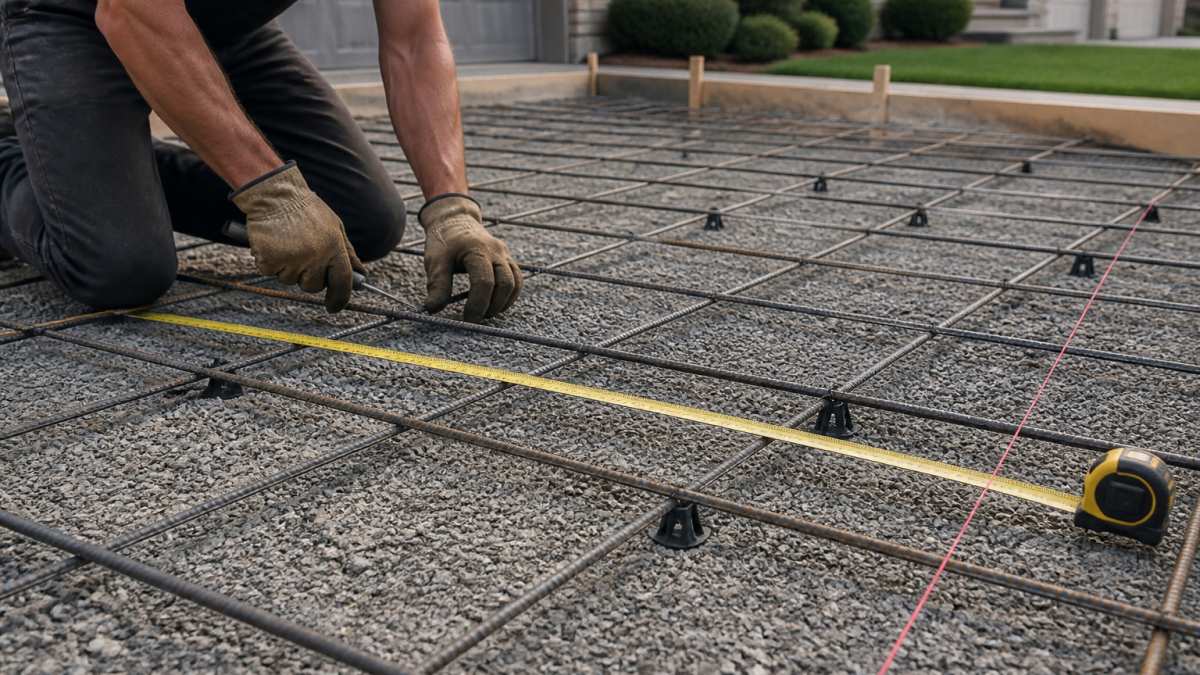
What correct placement looks like
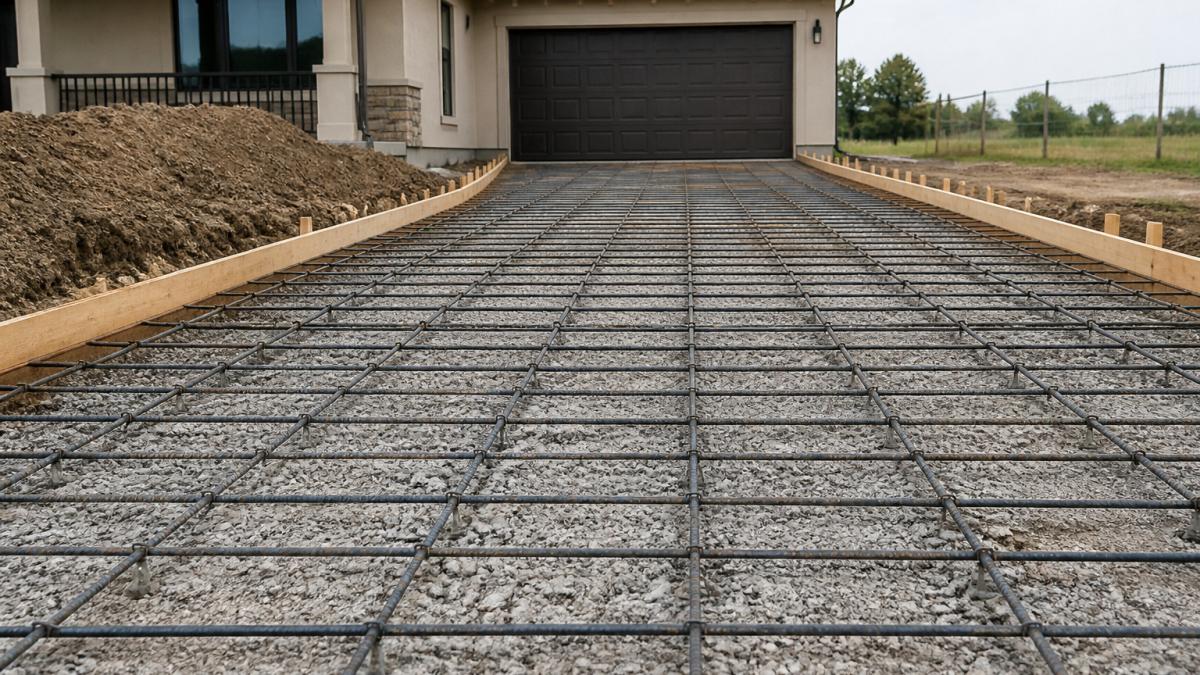
- Chairs, not ground contact. The grid should sit on rebar chairs or bolsters so it lands in the middle or lower third of the slab. Steel lying on the subgrade contributes almost nothing.
- Concrete cover. Aim for about 2 inches of concrete between the rebar and the soil, and at least 1.5 to 2 inches from the top surface and form edges. Cover is what protects the steel from moisture and road salt.
- Tied intersections. Overlap bars at crossings and tie them with wire so the grid stays rigid when workers walk on it and concrete is placed.
- Edge distance. Keep the grid roughly 2 inches inside the forms so the steel is fully encased.
- Stability during the pour. Workers should not stand on the grid or hook it with a rake. If bars shift, they need to be pulled back into position before the concrete sets.
A homeowner check before the pour
Spacing and placement work together. A tight grid set on the ground is worse than a wider grid held at the right depth, because the steel has to bond with concrete to carry tension. Get both right and the slab behaves the way the design intended.
Rebar vs. Wire Mesh for Driveways
For most driveways that see cars every day, rebar is the safer choice. For a closer look at how reinforcement is handled on heavier pours, see commercial foundation concrete pouring services.
Booking Your Driveway Pour With BK Concrete
A reinforced driveway is only as good as the crew that installs it. At BK Concrete LLC, we handle site preparation and grading.
Pricing depends on the project. For a current figure, check our Get a Concrete Driveway Replacement Quote: 2026 Guide to see what the project involves before we meet.
When you are ready to plan the pour, our Residential Concrete Driveway Cost Estimator gives you a starting point for your own driveway.
Frequently Asked Questions
Does every concrete driveway need rebar?
Most residential driveways benefit from rebar, but it is not the only option. Driveways that carry cars, trucks, or occasional heavy vehicles, sit on soils that expand and contract, or are longer than a typical slab face a higher risk of cracking and shifting. A small pedestrian-only pad may get by with fiber reinforcement alone. The right choice depends on slab thickness, expected loads, and soil conditions, so a contractor can confirm the specification for your site before the pour.
How far apart should rebar be spaced in a driveway?
A common starting point for residential driveway slabs is rebar on 18-inch centers in both directions, though spacing should be confirmed against the project design and local practice. Tighter spacing adds control where loads are heavier. The rebar should sit in the middle to upper third of the slab, supported on chairs so it does not rest on the subgrade, and should be kept at least 2 inches from the surface to protect it from corrosion.
Does rebar prevent a concrete driveway from cracking?
Rebar does not prevent all cracking. Concrete shrinks as it cures, and some hairline cracks will appear regardless of reinforcement. Rebar holds cracks tightly closed and helps the slab carry loads without separating, which limits the damage. Control joints cut into the surface at planned intervals guide where cracks form, and they work alongside reinforcement rather than replacing it.
What is better for a driveway, wire mesh or rebar?
Rebar generally provides stronger reinforcement for driveways because its ribbed steel bars carry tensile forces that concrete cannot handle alone. Welded wire mesh is lighter and easier to place, and it works for light-duty slabs such as patios or walkways. For a driveway that supports vehicles, rebar is usually the better choice, and wire mesh is best reserved for low-load applications.
Ready to get started? Contact BK Concrete LLC to talk through your reinforcement options and schedule your pour.